


"Recruiting platform" covers a lot of ground. Search for it and you'll find job boards, sourcing databases, enterprise applicant tracking suites and AI assistants all lumped into the same lists, most of them written for in-house HR teams at large companies.
Recruiting agencies need something more specific. You're managing candidates and clients at the same time, running several searches at once, and getting paid on placements, not headcount plans. The platforms that work for an agency look different from the ones that work for a corporate talent team.
This list is built for agency recruiters. It's organized by the job each platform does in an agency stack: the ATS and CRM that runs your desk, the sourcing tools that fill your pipeline, the note-takers that capture your calls, and the scheduling layer that gets interviews on the calendar.
What makes a recruiting platform right for an agency
A few requirements separate agency-ready platforms from general hiring software:
Candidates and clients in one system. Agencies sell to clients and recruit candidates at the same time. A platform that only tracks applicants, with no real client or business development side, leaves half the job in spreadsheets.
Built around placements and ownership. Agency workflows revolve around submittals, candidate ownership, fees and placements. Corporate ATS platforms are built around requisitions and internal approvals instead.
Works with people outside your company. Your clients' hiring managers will never log into your system. The best agency platforms account for that through client portals, shareable links, or integrations that don't require any setup on the client's side.
Connects to the rest of your stack. No single platform does everything well. Integrations with your ATS matter more than a long feature list, because anything that doesn't write back to your system of record turns into double entry.
ATS and CRM platforms for recruiting agencies
1. Loxo
Loxo is an agency-focused platform that combines an ATS, a CRM, a large candidate database for sourcing, and multi-step outreach in one system. For small and mid-sized agencies that want to source, engage and track candidates without stitching together several tools, it covers a lot of ground in a single subscription.
Where it's lighter is the coordination between your candidate and your client once someone wants to interview. That step usually still runs through email.
Best for: small to mid-sized agencies that want sourcing, outreach and an ATS in one platform.
2. Bullhorn
Bullhorn is one of the most established ATS and CRM platforms in the staffing industry and is widely used by larger staffing and recruiting firms. Its biggest strength is breadth: a mature core product plus a large marketplace of integrations, so most tools in the recruiting space connect to it in some way.
The tradeoff is weight. Bullhorn is built for firms with the operations resources to configure and manage it, and smaller agencies sometimes find it more platform than they need.
Best for: larger staffing and recruiting firms that need a deeply configurable system and a broad integration ecosystem.
3. Recruiterflow
Recruiterflow is an ATS and CRM built specifically for recruiting and staffing agencies, with a heavy emphasis on automation. Email sequences, pipeline-triggered workflows and AI-assisted features are central to the product, so it suits agencies that want to automate as much of the desk as possible.
Like most ATS platforms, it's stronger on candidate engagement than on coordinating interviews between two external parties.
Best for: agencies that want automation-heavy workflows and sequencing built into their ATS.
4. Crelate
Crelate is an ATS and CRM aimed at recruiting agencies and executive search firms. It's built for relationship-driven work, with a client portal where hiring managers can review submitted candidates and leave feedback.
The portal is genuinely useful when clients actually log in. In practice many don't, so agencies still end up coordinating interviews over email.
Best for: agencies and search firms running relationship-heavy desks that want candidate and client records tightly connected.
5. Recruit CRM
Recruit CRM is an ATS and CRM popular with small and mid-sized agencies, known for an approachable interface and pricing that works for smaller teams. It covers pipeline tracking, client management, calendar sync and a client portal without a long implementation.
Best for: small and growing agencies that want an intuitive, all-in-one ATS and CRM without enterprise complexity.
Sourcing platforms
6. LinkedIn Recruiter
LinkedIn Recruiter is still the default sourcing tool for most agency recruiters, simply because it's where most professional candidates keep a profile. Recruiter Lite covers independent recruiters and small teams, while the full Recruiter product adds deeper search and collaboration features for larger firms.
It's a sourcing tool, not a system of record, so most agencies pair it with one of the ATS platforms above.
Best for: any agency recruiter doing outbound sourcing for professional roles.
7. Pin
Pin is an AI recruiting platform that searches a large database of candidate profiles, ranks matches against your role, and runs multi-channel outreach sequences from the same place. Instead of writing Boolean strings, you describe the candidate you want in plain language and work from a ranked shortlist. It's used by staffing agencies, boutique firms and independent recruiters, and it's a good fit for agencies running several client searches in parallel.
Pin also includes scheduling, but it's built around candidates booking time on your calendar. Coordinating an interview between your candidate and your client's hiring manager is a separate problem.
Best for: agencies that want AI sourcing and automated outreach in one tool.
8. Juicebox
Juicebox is an AI sourcing platform built around natural-language search across hundreds of millions of profiles drawn from dozens of data sources. Alongside search, it offers AI sourcing agents that keep working in the background, AI-assisted email outreach, and a lightweight recruiting CRM. Its customers range from in-house teams at high-growth companies to boutique agencies and independent recruiters.
Best for: recruiters filling hard-to-find or technical roles who want a powerful search engine alongside, or instead of, LinkedIn.
AI note-taking platforms
9. Metaview
Metaview started as an AI note-taker built specifically for recruiting conversations and has grown into a broader AI recruiting platform with sourcing, application review and reporting. Its core strength is still the notes: intakes, screens and interviews are recorded, transcribed and summarized into structured notes, with custom templates for different call types.
Its deepest integrations are with in-house ATS platforms like Greenhouse, Lever, Ashby and Workday, which reflects its large base of corporate talent teams, though recruiting agencies and search firms use it too.
Best for: recruiting teams that want best-in-class interview notes and are open to a broader AI recruiting suite.
10. CoRecruit
CoRecruit (formerly Quil) is an AI recruiting assistant built specifically for staffing agencies and executive search firms. It captures calls without a visible meeting bot, covering phone calls, video meetings, WhatsApp and in-person conversations, then writes structured notes directly into your ATS. It integrates with agency platforms including Bullhorn and Loxo and can turn call notes into client-ready candidate submittals.
General meeting note-takers like Granola work fine for internal calls, but they don't know what an intake or a candidate screen should produce, and they don't write back to your ATS.
Best for: agencies and search firms that want call notes and submittals written straight into their ATS without a bot joining the call.
Interview scheduling platforms
11. Arrange
Every platform above helps you find candidates, talk to them and keep track of them. None of them really solves the moment a client says they want to meet someone. That's when the email chain starts: ask the candidate for times, forward them to the client, wait, confirm with the candidate, then log it all in the ATS.
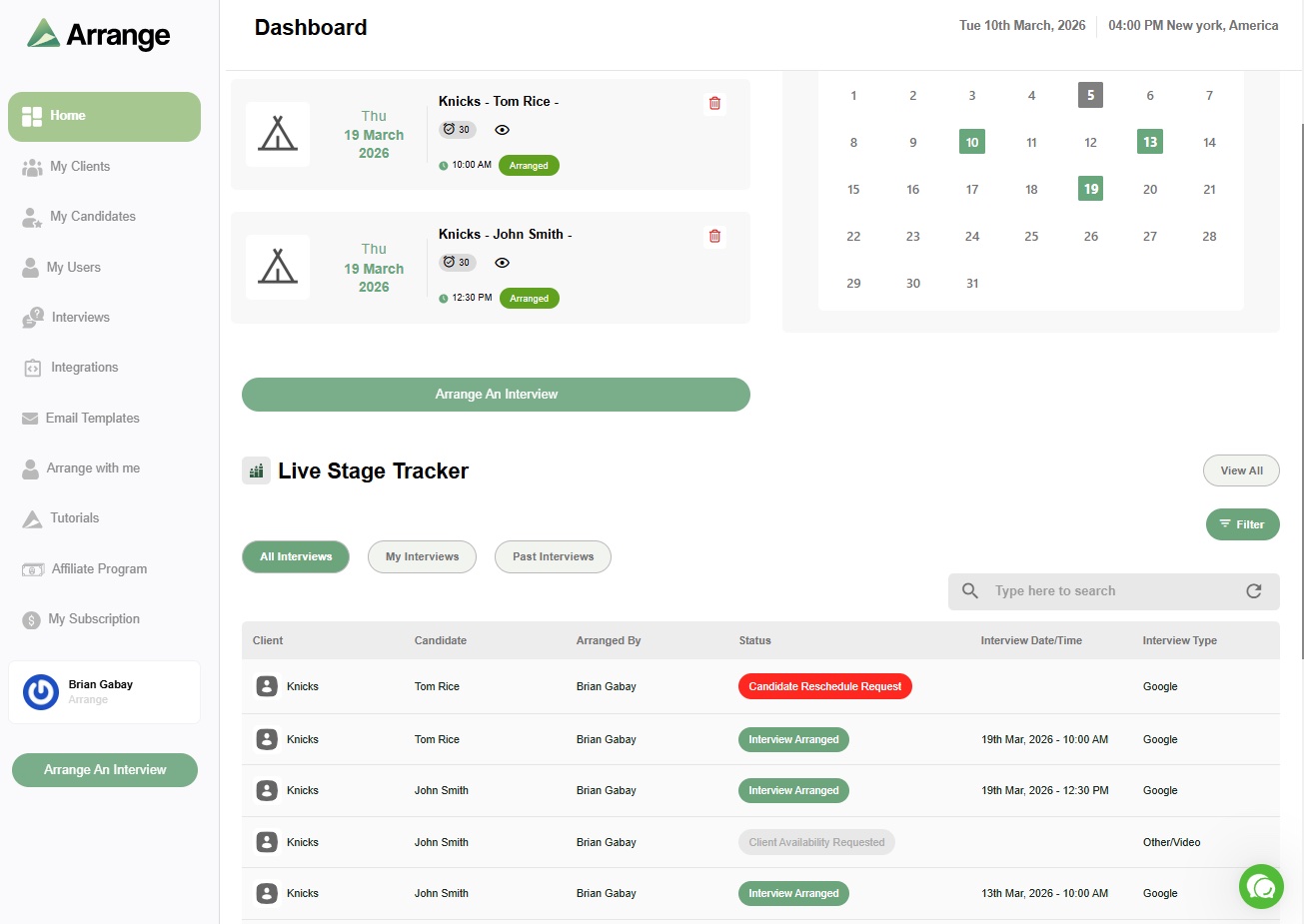
Arrange is an interview scheduling platform built for that gap. Instead of relaying availability back and forth, you choose how the interview gets booked. Candidate First collects the candidate's availability and lets the client pick from it. Client First gets the client's availability and sends it to the candidate to choose a time. Matchmaker collects availability from both sides and books the earliest overlap automatically. You can also add a Submission Link to your candidate submission, so if your client wants to meet, they click it and choose how to schedule.
Neither the candidate nor the client needs to create an account or log in, and everything they see carries your agency's branding. Arrange integrates with Loxo, Bullhorn, Crelate, Recruiterflow and Recruit CRM and more, so when an interview is confirmed, the candidate's stage advances and the interview details are logged in your ATS automatically.
Best for: recruiting agencies that want interviews booked without the back-and-forth, on top of the ATS they already use.
How to build your agency's platform stack
Most agencies don't need one platform that does everything. They need a few layers that work together and all write back to the same system of record.
A system of record. Pick the ATS and CRM that fits your size and style. Smaller agencies often start with Loxo or Recruit CRM. Automation-focused teams tend to like Recruiterflow, relationship-heavy search firms lean toward Crelate, and larger staffing operations usually end up on Bullhorn.
A sourcing channel. LinkedIn Recruiter covers most agencies. AI sourcing tools like Pin and Juicebox are worth adding if you're filling hard-to-find roles or running many searches at once.
A note-taker. If your recruiters spend their days on screens and intake calls, an AI note-taker that writes to your ATS, like CoRecruit or Metaview, gives back hours of admin every week.
A scheduling layer. This is the layer agencies most often skip, and it's where a lot of time disappears. Generic booking tools like Calendly work for screening calls where you're one of the attendees, but they're built for two people, not for coordinating between a candidate and a client. Enterprise schedulers like GoodTime assume every interviewer is inside your company and on your calendar system. Agencies need a scheduling tool built for the person in the middle.
Where Arrange fits
Arrange doesn't replace your ATS. It sits alongside it and handles the one part of the job your ATS wasn't designed for: getting a candidate and a client into the same interview without a week of email. You can start on the free plan and upgrade when you're ready to connect your ATS and use every scheduling flow.
Frequently asked questions
What is a recruiting platform?
A recruiting platform is software that helps recruiters find, track and place candidates. The term covers several categories, including applicant tracking systems, recruiting CRMs, sourcing tools, AI note-takers and interview scheduling tools. Most recruiting agencies use a combination of these rather than a single all-in-one product.
What's the best recruiting platform for a small recruiting agency?
For most small agencies, an all-in-one ATS and CRM like Loxo or Recruit CRM is the best starting point, since both combine candidate and client management without a heavy implementation. Add LinkedIn Recruiter or an AI sourcing tool for sourcing, and a dedicated scheduling layer once interview coordination starts eating into your week.
Do recruiting platforms include interview scheduling?
Most ATS and sourcing platforms include calendar sync or basic booking links, but they're usually built for booking time on your own calendar or for internal hiring teams that can see their interviewers' calendars. Recruiting agencies coordinate between candidates and clients at separate companies, which is why many add a dedicated scheduling tool that works without either party logging in.


.jpg)

.jpg)
.jpg)