

Most interview scheduling tools get recommended because they're popular - not because they were built for the way recruiting agencies actually work. GoodTime, ModernLoop, Calendly - all strong products, all designed for a different problem than the one most agency recruiters face every day.
This list focuses on what actually works for external recruiting agencies: tools that handle the three-party coordination between you, your candidate, and your client, without requiring anyone to log in or create an account in a system that isn't theirs.
What agency recruiters actually need from a scheduling tool
The agency recruiter use case is structurally different from in-house recruiting. You don't have access to your client's calendar. Your client isn't inside your ATS. And when it comes to scheduling an interview, you're coordinating between two people who have no shared system and no direct relationship with each other.
That means a good scheduling tool for agencies needs to:
- Collect availability from a candidate and a client independently, without requiring either to log in
- Find the overlap automatically and confirm the interview without manual cross-referencing
- Keep you visible as the coordinator - not hand everything off and leave you blind to what's happening
- Sync confirmed interviews back to the ATS platforms agencies actually use
Most scheduling tools handle two of these. Few handle all four. Here's where the main options land.
The best interview scheduling tools for recruiting agencies in 2026
1. Arrange

Arrange is the only tool on this list built specifically for the agency recruiter use case. The entire product is designed around the fact that you're the coordinator in the middle - not the hiring manager, not the candidate, not an internal TA team with calendar access.
The core scheduling flows give you flexibility depending on how a particular client relationship works. Candidate First collects the candidate's availability and lets you share a filtered set with your client to confirm. Client First pulls the client's open times and gives the candidate a booking link. Matchmaker collects from both sides at once and auto-confirms the first overlap - no manual cross-referencing, no back-and-forth.
Arrange Connect adds a layer for clients you have a strong enough relationship with to request calendar access. They connect via a permission link and candidates book directly against live availability. No accounts required on either side.
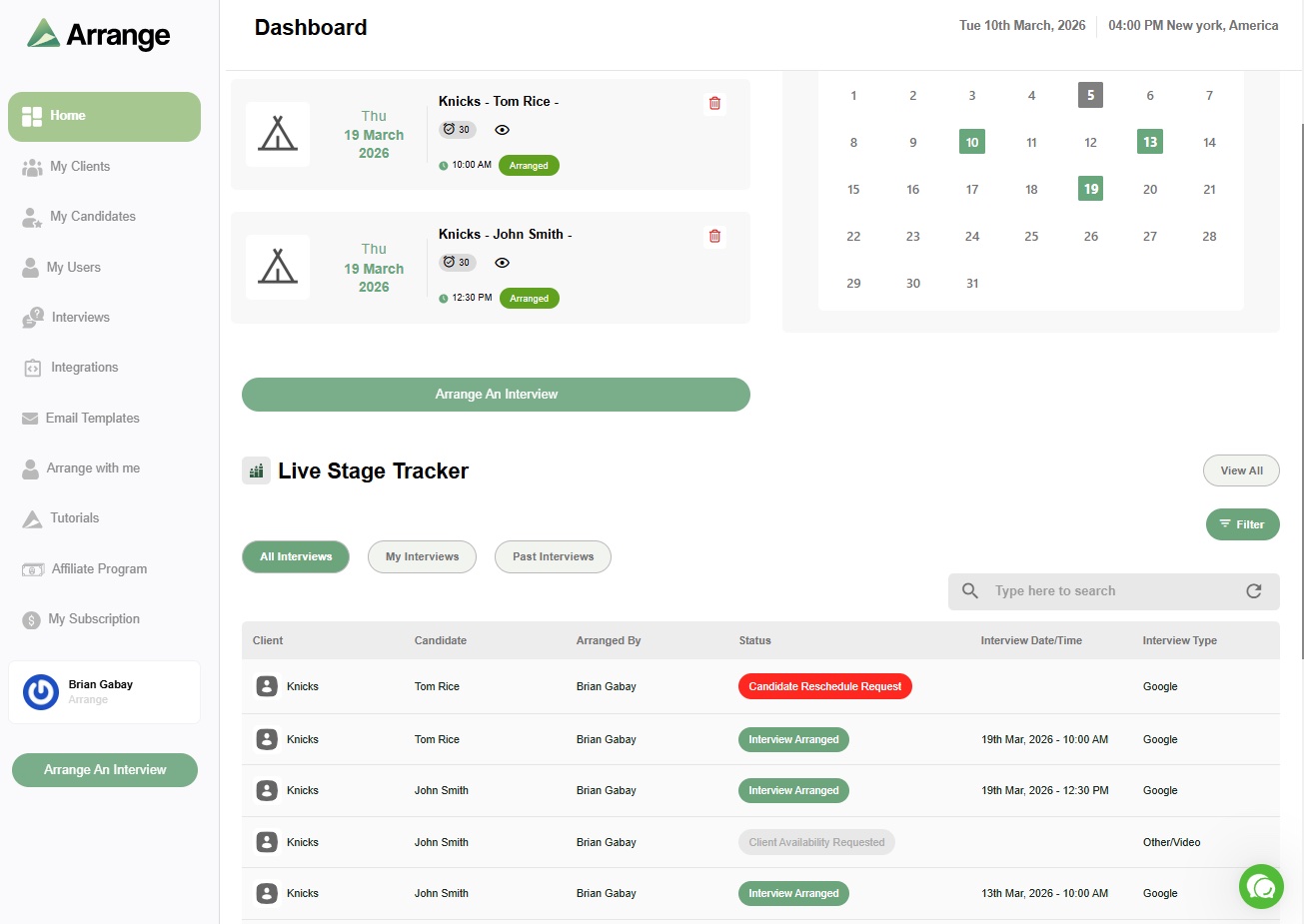
The live stage tracker gives you real-time visibility across all your active interviews - who's submitted availability, who's waiting, what's confirmed. You're not finding out something fell through after the fact.
White-labeling means candidates and clients see your branding throughout. ATS integrations with Loxo, Crelate, Recruiterflow, and RecruitCRM sync confirmed interviews back automatically - the candidate's stage advances and the interview details are logged without manual input.
Best for: external recruiting agencies of any size coordinating interviews between candidates and clients who aren't in the same system.
Pricing: ~$35/user/month. 14-day free trial at letsarrange.io.
2. GoodTime

GoodTime is a powerful enterprise scheduling platform built for large in-house talent acquisition teams. It handles panel coordination, interviewer load balancing, ATS-triggered automation, and deep integrations with Greenhouse, Lever, and Workday. For companies running hundreds of interviews a month with dedicated recruiting coordinators, it delivers real operational leverage.
For external agencies, the architecture assumes organizational infrastructure that doesn't exist in the agency context. GoodTime's automation depends on reading hiring team calendars and coordinating internal interviewers. When your interviewers are client-side hiring managers at ten different companies, that model breaks down.
Best for: enterprise in-house TA teams with high interview volume and full calendar access. Not designed for external agencies.
Pricing: Custom, enterprise-tier. Typically starts around $25,000/year.
3. ModernLoop
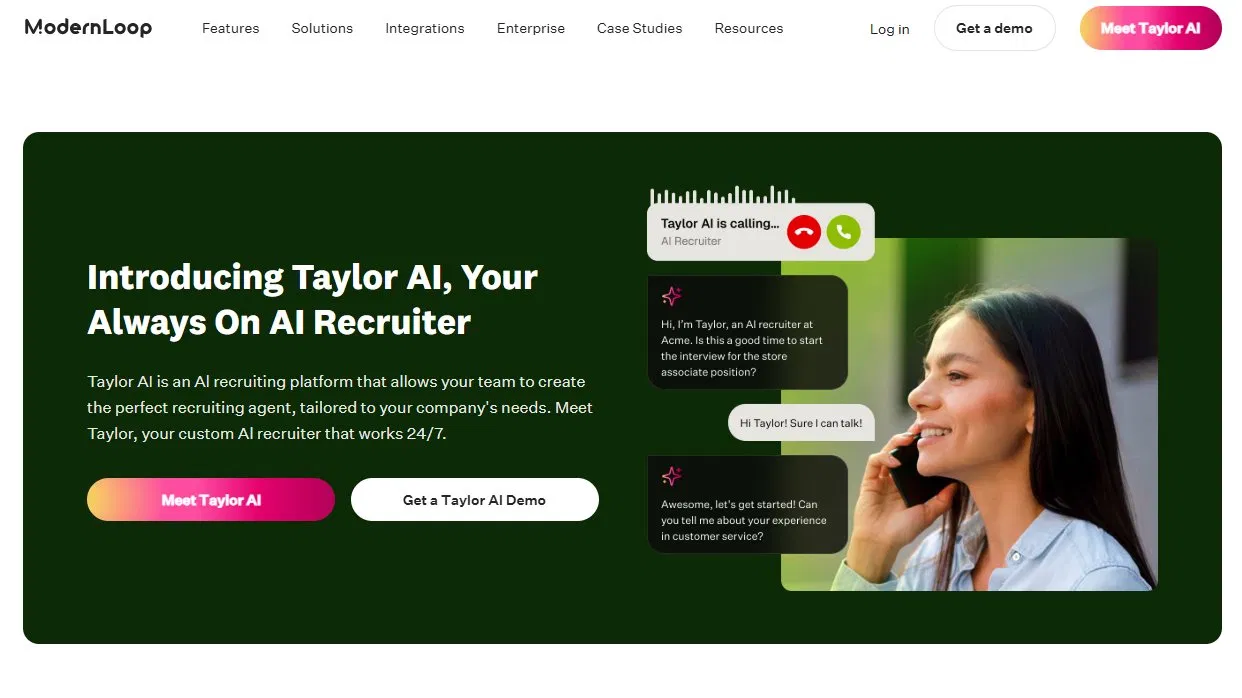
ModernLoop is closely positioned to GoodTime - an enterprise coordination platform for in-house teams running structured interview processes at scale. Zero Click Scheduling, interviewer calibration tracking, and deep ATS integrations make it a strong product for the right context.
Same limitation as GoodTime for agencies: it assumes your interviewers are employees whose calendars you can sync. External clients at separate companies don't fit that model.
Best for: scaling in-house recruiting teams with dedicated coordinators running structured, high-volume hiring.
Pricing: Custom, not publicly listed. Enterprise positioning.
4. Calendly
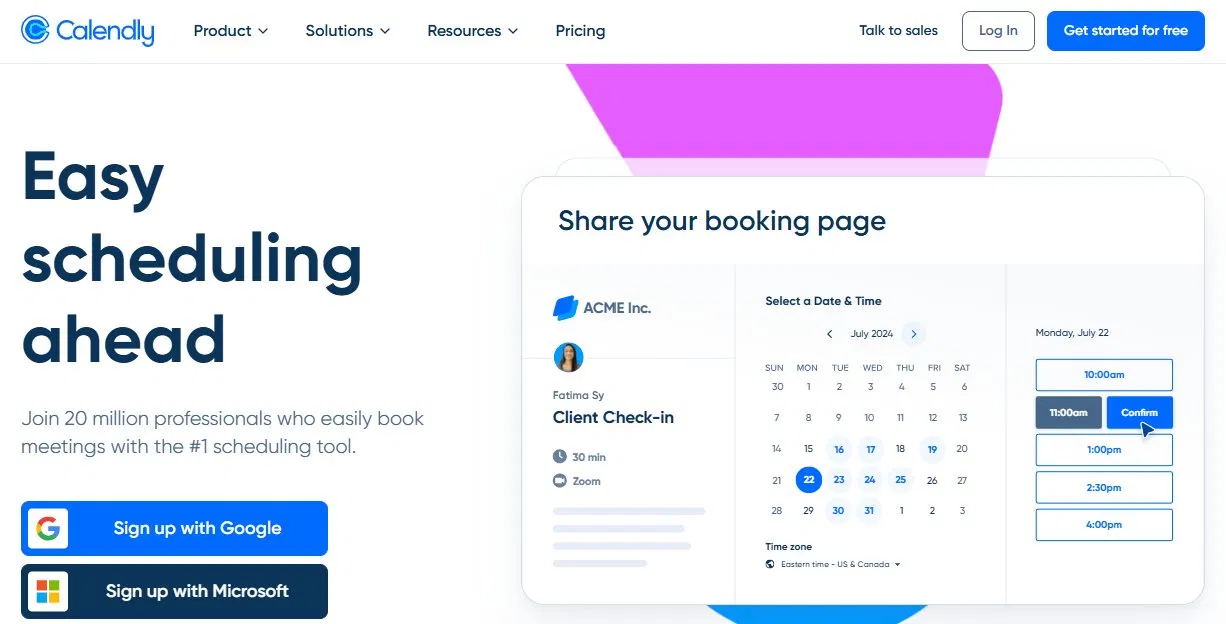
Calendly is the most widely used scheduling tool in recruiting and the default starting point for most teams. It's easy to set up, broadly recognized by candidates, and genuinely effective for simple one-on-one booking. Many recruiters use it for initial phone screens without any friction.
The ceiling for agencies is the coordination model. Calendly is built for the person who owns the link - you set your availability and someone books time with you. For coordinating between two external parties who both need to share availability independently, Calendly doesn't have a native workflow. You end up managing the client side manually. It also doesn't integrate natively with the ATS platforms most agencies use - Loxo, Crelate, Recruiterflow, RecruitCRM - so confirmed interviews need to be logged by hand.
Best for: recruiters booking initial screens or calls where the recruiter is one of the participants.
Pricing: Free plan available. Standard at $10/user/month, Teams at $16/user/month.
5. Paradox
Paradox (acquired by Workday in October 2025) uses conversational AI to automate candidate screening and scheduling via SMS and chat. For high-volume frontline hiring in retail, healthcare, and hospitality, it's a genuinely differentiated product - candidates can schedule through a text conversation without any recruiter involvement.
For professional-level recruiting or agency use, the conversational AI approach doesn't fit. It's designed for employers doing volume hiring, not for agencies coordinating between candidates and clients across multiple professional-level searches.
Best for: enterprise companies doing high-volume frontline hiring who want to automate candidate scheduling end-to-end.
Pricing: Enterprise pricing, typically $30,000-$100,000+/year.
How to choose the right tool
The clearest way to narrow it down: are you coordinating interviews between people inside your organization, or between external parties who don't share any system?
In-house teams coordinating internal hiring managers and candidates should look at GoodTime or ModernLoop. They're built for that model and handle it well.
External agencies coordinating between clients and candidates who aren't in their system need a different kind of tool. GoodTime and ModernLoop assume organizational infrastructure that agencies don't have. Calendly handles the simple booking case but not the coordination case. Arrange is the only tool on this list built specifically for the external agency workflow.
For more on how scheduling tools handle ATS integration, see what interview scheduling platform integrates with ATS systems. And if you're wondering whether your ATS's built-in scheduling is enough, your ATS has scheduling - here's why that's not enough covers that gap.
Frequently asked questions
What is the best interview scheduling tool for recruiting agencies?
Arrange is the only interview scheduling tool built specifically for external recruiting agencies. It handles three-party coordination between recruiters, candidates, and clients without requiring login on either side, and integrates natively with Loxo, Crelate, Recruiterflow, and RecruitCRM.
Can I use Calendly for interview scheduling as a recruiter?
Calendly works well for booking initial screens where you're one of the participants. For coordinating actual interviews between a candidate and a hiring manager at a client company - where you need to collect availability from both sides - Calendly doesn't have a native workflow for that. You'd still be managing the coordination manually.
What's the difference between GoodTime and Arrange?
GoodTime is built for in-house TA teams at enterprise companies with direct access to hiring manager calendars. Arrange is built for external recruiting agencies coordinating between candidates and clients who aren't inside the same organizational system. They solve different problems.
Do interview scheduling tools integrate with recruiting ATS platforms?
Most do, but the integrations vary significantly. GoodTime and ModernLoop integrate with Greenhouse, Lever, and Workday. Arrange integrates natively with Loxo, Crelate, Recruiterflow, and RecruitCRM - the platforms most external agencies actually use.


.jpg)

.jpg)
.jpg)