


A single interview between a candidate and one interviewer is a solved problem. Most scheduling tools handle it fine. The trouble starts when a role requires a multi-day loop, several interviewers, sometimes across departments, spread over two or three days, with the candidate needing to make it through all of them before a decision gets made.
This is where a lot of scheduling software quietly stops working the way it's advertised. Here's what actually makes multi-day, cross-functional loops hard, and what to look for in a tool that handles them well.
Why multi-day loops are harder than they look
A few things compound at once in this scenario that don't show up in a simple one-on-one booking:
More people means more conflicts. Every additional interviewer added to a loop multiplies the number of calendar conflicts that can arise. Finding one open slot between two people is straightforward. Finding a coherent sequence of slots across five people over two days is a genuinely different problem.
Cross-functional means less shared context. When interviewers span departments, engineering, sales, ops, whoever, they're not used to coordinating with each other and often don't share visibility into the loop as a whole. Someone on the loop can end up double-booked without anyone noticing until the candidate is already mid-process.
Sequencing matters, not just availability. A multi-day loop usually needs to happen in a specific order, screening before the panel, panel before the final round, which means a scheduling tool needs to understand dependencies, not just find open slots.
One reschedule can cascade. If day one shifts, it can affect availability for day two or three, especially if interviewers are shared across days. A tool that treats each interview as an isolated event misses this entirely.
What to look for in a tool built for this
A few specific capabilities separate tools that handle multi-day loops well from ones that just handle single interviews:
Multi-interviewer availability matching in one pass. The tool should be able to take several interviewers' calendars and find a coherent set of slots across all of them, not require you to book each interviewer individually and manually check for conflicts afterward.
Slot visibility that updates as the loop fills in. As parts of the loop get booked, the remaining open slots should reflect that automatically, so nobody accidentally gets offered a time that's no longer available because of an earlier confirmation.
Support for sequencing across multiple days. The tool should understand that day two depends on day one being scheduled first, rather than treating every interview in the loop as independent.
A single source of truth for the whole loop. Everyone involved, the recruiter, the interviewers, the candidate, should be able to see the state of the full loop rather than piecing it together from separate calendar invites and email threads.
Why this is especially hard for external recruiting agencies
Everything above gets harder when the interviewers are at a client company rather than inside your own organization. As an agency recruiter, you don't have visibility into the client's internal calendars, you're not the one who can see when someone on their side is double-booked, and you're relying entirely on the client to flag conflicts that an internal coordinator would catch automatically.
That means the coordination burden for multi-day, cross-functional loops falls disproportionately on the agency recruiter, who has the least visibility into what's actually happening on the client side. A tool that requires calendar access you don't have, or assumes interviewers are internal employees, doesn't solve this problem for you even if it solves it well for in-house teams.
Where Arrange fits
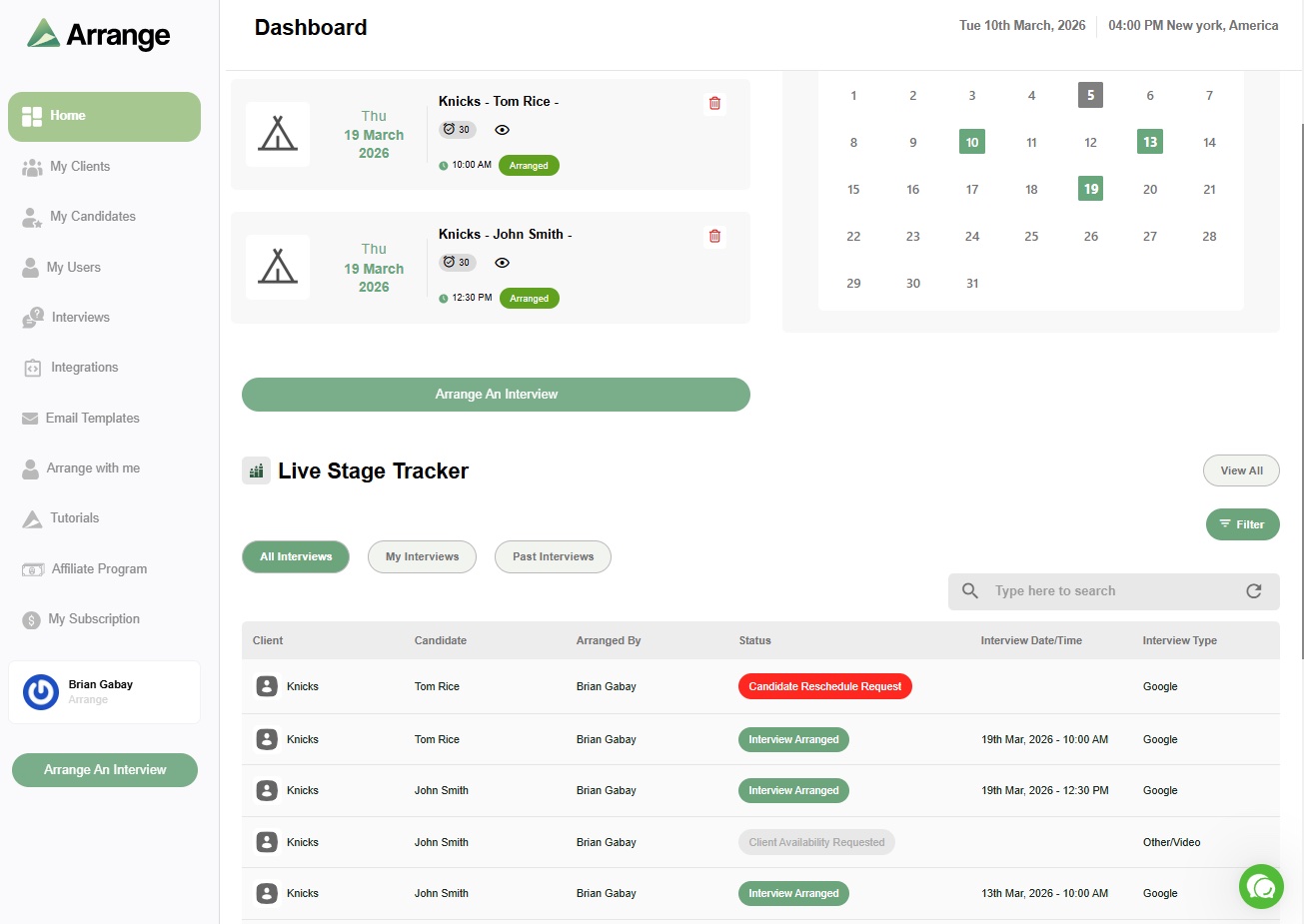
Multi-day, cross-functional loop scheduling is an area we're actively building into Arrange. Today, Arrange Connect lets recruiters multi-select several hiring managers who've connected their calendars and generate a single group booking link on their behalf, which handles a meaningful chunk of the panel coordination problem without requiring calendar access on the recruiter's side.
A more complete multi-day loop experience, with built-in sequencing across days and slots that update automatically as each stage of the loop gets booked, is on our roadmap. If this is a recurring pain point for your team, it's worth reaching out, we're actively shaping that feature around real agency workflows right now.
FAQ
What makes multi-day interview loops harder to schedule than single interviews?
Every additional interviewer multiplies the number of possible calendar conflicts, and when interviewers span departments, they often lack shared visibility into the loop as a whole. Sequencing also matters, later days often depend on earlier days being confirmed first, which most single-interview scheduling tools don't account for.
Can Calendly or similar tools handle multi-day, cross-functional interview loops?
Not well. Tools built for one-on-one or single-event booking don't have native support for sequencing multiple days or automatically updating availability across a loop as parts of it get booked. Most recruiters using these tools for multi-day loops end up manually cross-referencing calendars as a workaround.
How do external recruiting agencies handle multi-day interview loops with client interviewers?
It's harder for agencies than in-house teams, since the recruiter typically has no visibility into the client's internal calendars and relies on the client to flag conflicts. Tools that let a client-side hiring manager connect their calendar directly, without requiring agency-side calendar access, help close that visibility gap.
Is Arrange building dedicated multi-day loop scheduling?
Yes, a more complete multi-day loop experience with built-in sequencing is on our roadmap. Today, Arrange Connect already supports multi-selecting several connected hiring managers to generate a single group booking link, which covers a meaningful part of the panel coordination problem.


.jpg)

.jpg)
.jpg)