Both recruiting agencies and in-house talent acquisition teams schedule interviews. On the surface the task looks identical - get a candidate and a hiring manager in a room together at an agreed time.
But spend five minutes talking to someone from each side and you quickly realize they're dealing with fundamentally different problems.
The tools that work for one rarely work for the other. The workflows that make sense for one create friction for the other. And the scheduling back and forth that feels manageable for one can be completely paralyzing for the other.
Here's a clear breakdown of the difference - and why it matters when you're choosing how to handle interview coordination.
How in-house TA teams schedule interviews
In-house talent acquisition teams work within a single organization. They have access to the company's calendar infrastructure - usually Google Workspace or Microsoft 365 - which means they can often see hiring manager availability directly.
When an in-house recruiter needs to schedule an interview, the typical workflow looks like this: check the hiring manager's calendar, find an open slot, send the candidate a time or a booking link, confirm, and add the event. If the hiring manager is hard to reach, the recruiter can often book directly into their calendar with appropriate permissions.
The candidate is always external, but the hiring manager is internal. That internal access changes everything. It means one side of the coordination equation is largely solved before the recruiter even starts.
In-house teams also tend to use applicant tracking systems that are deeply integrated with their calendar infrastructure. When a candidate moves to the interview stage in Greenhouse or Lever, the scheduling workflow is often built directly into that same system.
None of this makes in-house scheduling effortless. Hiring managers are busy. Panel interviews with multiple stakeholders are complex. High volume roles create their own kind of chaos. But the structural foundation - one organization, shared calendar access, integrated tools - makes the problem manageable with relatively generic scheduling software.
How agency recruiters schedule interviews
Agency recruiters operate outside any single organization. They work with multiple clients simultaneously, each with their own calendar systems, communication preferences, and response patterns. And they work with candidates who are external to everyone.
When an agency recruiter needs to schedule an interview, the workflow looks like this: reach out to the candidate for availability. Take that availability to the client. Wait for the client to respond. Go back to the candidate if the times don't work. Wait again. Confirm. Send a calendar invite manually to both parties.
Neither the candidate nor the client is internal. Neither has any obligation to respond quickly. Neither shares a calendar system with the recruiter or with each other. Every piece of coordination has to flow through the recruiter manually.
Agency recruiters also typically work across dozens of active searches at any given time. The scheduling back and forth that might be a minor inconvenience on one role becomes a significant time drain when multiplied across ten or fifteen active candidates and multiple clients.
And unlike in-house teams who use a single ATS for their entire organization, agency recruiters use their own ATS - Loxo, Crelate, RecruitCRM, Recruiterflow - which has no native connection to the client's calendar or HR systems. Every integration has to be built around the recruiter, not the organization being hired for.
The structural difference that makes agency scheduling harder
The core difference comes down to one thing: internal vs external coordination.
In-house teams coordinate between one external party (the candidate) and one internal party (the hiring manager). The internal side is accessible, accountable, and on the same systems.
Agency recruiters coordinate between two external parties - a candidate and a client - who have no relationship with each other, no shared systems, and no particular incentive to respond to each other's schedules. The recruiter sits in the middle of every exchange.
This is why generic scheduling tools work reasonably well for in-house teams and fall short for agency recruiters. A tool like Calendly lets you share your own availability with one other person. That works when you're the one being scheduled. It doesn't work when you need to coordinate two other people's availability without being one of the attendees.
The three-party coordination problem - recruiter, candidate, client - is structurally different from the two-party problem that most scheduling software was designed to solve.
Where the tools diverge
In-house TA teams are well served by scheduling features built into their ATS, supplemented by tools like Calendly or GoodTime for more complex interview loops. These tools assume calendar access, shared organizational infrastructure, and a relatively predictable hiring workflow.
Agency recruiters need something different. Specifically they need:
A way to collect availability from two external parties independently - without either party needing to create an account, log in, or interact with each other directly.
Flexibility in which party goes first - sometimes the candidate shares availability first, sometimes the client does. A rigid tool that only handles one direction creates manual workarounds.
Automatic calendar invite delivery to all parties when a time is confirmed - not just a confirmation email, but an actual calendar event that shows up where it needs to show up.
ATS integration that updates the candidate's stage automatically when an interview is confirmed - so the recruiter isn't manually logging every scheduling outcome.
White-labeled communication so the candidate and client experience feels like it's coming from the agency, not a third-party tool.
None of these requirements are exotic. But they're specific enough that very few tools address all of them. Most scheduling software was built for the simpler, two-party use case.
So who has the harder problem?
Agency recruiters. By a significant margin.
Not because in-house scheduling is easy - it isn't. High volume hiring, panel interviews, and unresponsive hiring managers create real challenges for in-house teams too.
But the structural foundation that in-house teams work from - shared organizational infrastructure, internal calendar access, integrated ATS workflows - eliminates a whole category of coordination friction that agency recruiters face on every single search.
Agency recruiters are solving a three-party coordination problem with tools built for two parties. That gap is where most of the scheduling back and forth lives. And it's the gap that purpose-built tools for agency recruiters are designed to close.
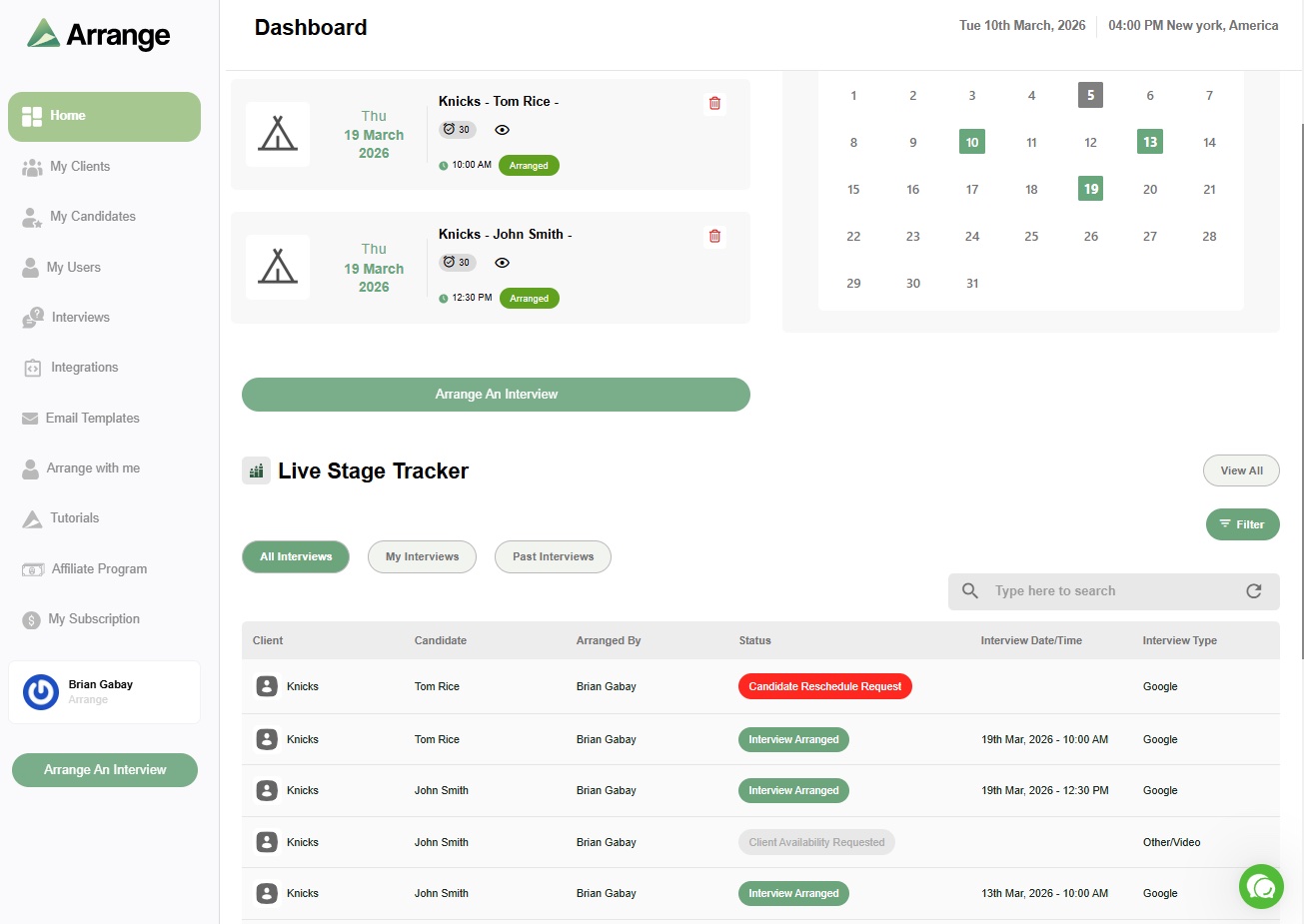
Arrange was built specifically for this use case. If you run an external recruiting agency and want to see what eliminating the scheduling back and forth actually looks like, there's a 14-day free trial at letsarrange.io. No credit card required.
FAQ
Can in-house TA teams use Arrange?
Yes. While Arrange was built specifically for the agency recruiter use case, in-house teams that coordinate interviews across multiple hiring managers and external candidates also benefit from the platform. The core workflow - collecting availability independently from multiple parties and confirming automatically - applies to both contexts.
Why don't generic scheduling tools work for agency recruiters?
Most scheduling tools were designed for single-sided scheduling - sharing your own availability with one other person. Agency recruiters need to coordinate between two external parties who have no shared calendar system. That three-party coordination problem requires a different kind of tool.
What ATS platforms does Arrange integrate with?
Arrange integrates with Loxo, Crelate, RecruitCRM, and Recruiterflow - the ATS platforms most commonly used by external recruiting agencies. When an interview is confirmed, the candidate's stage updates automatically and the interview details are logged without manual input.
Is interview scheduling harder at high-volume agencies?
Yes. The back and forth that feels manageable on one or two active searches becomes a significant time drain when multiplied across ten or fifteen simultaneous searches. High volume agency recruiters tend to feel the scheduling problem most acutely and see the largest time savings from automating it.


.jpg)
.jpg)
.jpg)