The real coordination problem
When an agency recruiter submits a candidate to a client, the next step is an interview. Simple enough in theory. In practice, it goes like this:
You email the candidate to ask for their availability. They reply with a few windows. You take those windows to the client. The client comes back with different times. You go back to the candidate. The candidate has already taken a call and one of the windows is gone. You go back to the client. The client asks if Monday works. You check with the candidate. Monday doesn't work anymore.
Four days. Eight emails. One interview, still not scheduled.
This is not a time management problem. It's a structural problem. You're acting as a human router between two people who can't talk to each other directly, using a tool (email) that was never designed for this workflow.
The back and forth isn't happening because anyone is being difficult. It's happening because the process forces it.
What the middleman role actually requires
To fix interview scheduling for agency recruiters, a tool needs to understand a few things that generic scheduling software doesn't:
First, neither the candidate nor the client should need to create an account or download anything. You're asking busy people to do you a favor by showing up for an interview. Adding friction to that process - even a simple login - reduces completion rates and creates a poor first impression of the agency.
Second, availability needs to be collected from both sides independently before they're matched. The candidate shouldn't see the client's calendar. The client shouldn't see the candidate's personal availability windows. Both parties share information through you, not with each other.
Third, the workflow needs to flex depending on who goes first. Sometimes you collect the candidate's availability and present it to the client for selection. Sometimes the client shares their availability and the candidate picks from those windows. Both scenarios happen in real agency work, and a rigid tool that only handles one direction creates workarounds.
Fourth, when an interview is confirmed, it should be confirmed everywhere simultaneously. The candidate gets a calendar invite. The client gets a calendar invite. You get confirmation. Nobody has to manually send anything.
How Arrange handles this
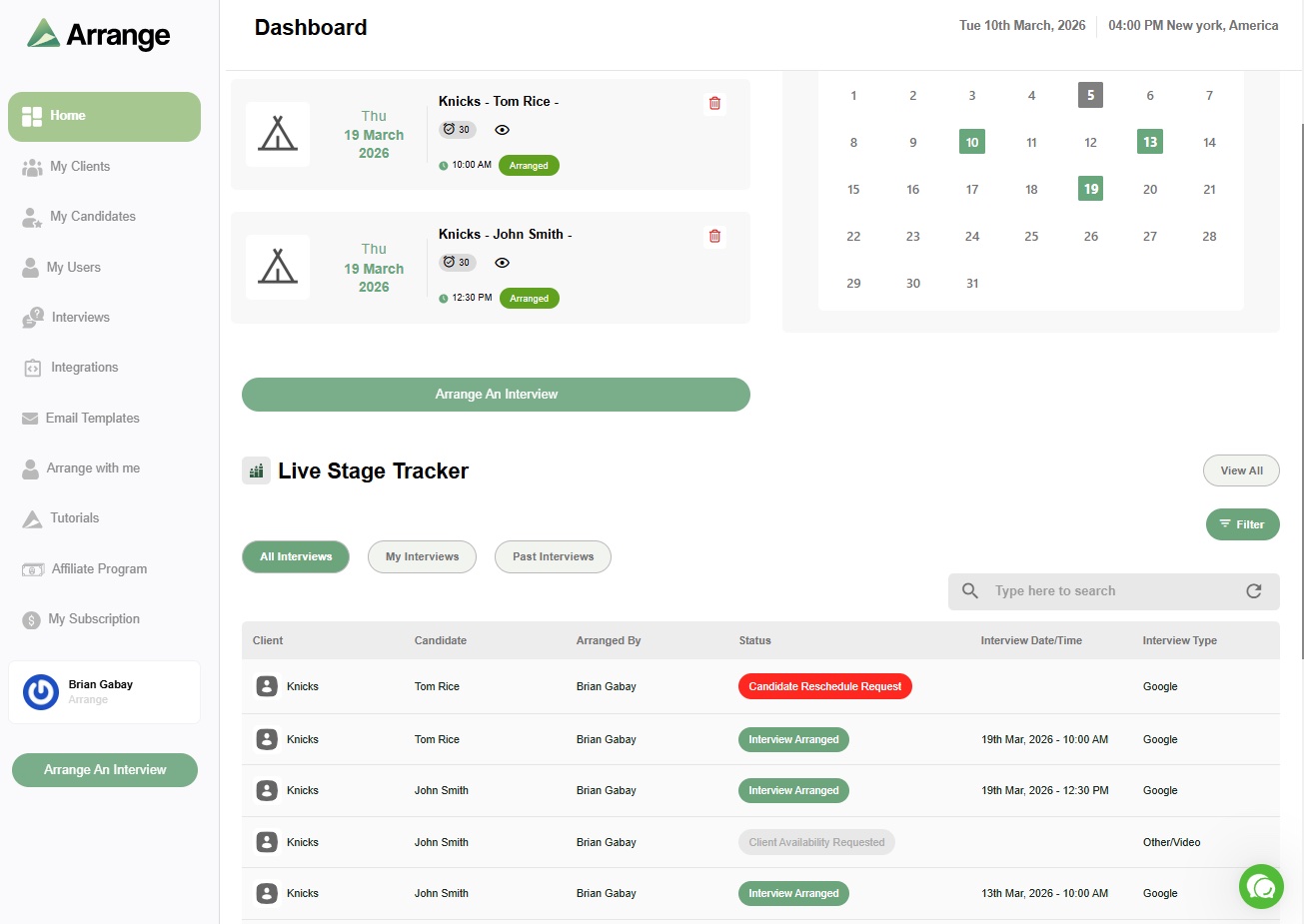
Arrange was built specifically for this workflow - by a recruiter who lived it.
The core feature is the Candidate Scheduling Link. Here's how it works in practice:
When you submit a candidate to a client, you include a scheduling link in the submission email. The client clicks it and sees two options: they can provide their own availability, or they can request the candidate's availability.
If the client provides their own availability, those windows are sent to the candidate, who selects the time that works best. If the client requests the candidate's availability instead, the candidate shares their open windows, which are then presented to the client for selection.
Either way, once a time is selected, Arrange automatically sends calendar invites to all parties. The interview is confirmed. Nobody had to exchange a single scheduling email.
The key detail that matters for agency work: neither the candidate nor the client creates an account or logs in to anything. They click a link, make a selection, and they're done. The experience is frictionless on both sides, which means higher completion rates and a cleaner impression of your agency.
ATS integrations
Arrange integrates with the ATS platforms that agency recruiters actually use. Current integrations include Loxo, Crelate, RecruitCRM, and Recruiterflow, with more in development.
The integration works the same way across platforms. When you create a scheduling link, you tag it to a specific job in your ATS. When the interview is confirmed, the ATS updates automatically - the candidate's stage advances and the interview details are logged without any manual data entry.
This closes the loop that most scheduling tools leave open. Confirming an interview and updating your ATS are typically two separate tasks. With Arrange connected to your ATS, they happen as one.
Why this matters beyond time savings
The obvious benefit of eliminating scheduling back-and-forth is time. For a recruiter running ten active searches, hours of coordination per week disappear.
But there's a less obvious benefit: the candidate and client experience improves.
When a candidate receives a scheduling link in the submission email rather than an availability request, the process feels professional and frictionless. When a client can pick an interview time with one click instead of exchanging emails, the agency looks organized and efficient.
Interview scheduling is one of the first operational touchpoints your candidates and clients have with your agency. How you handle it says something about how you operate. A tool built for the middleman role lets you handle it well.
The tools that weren't built for this
Most scheduling tools were designed for a single-sided use case. Calendly, for example, lets you share your availability with someone else. That works well if you're the person being scheduled. It doesn't handle the case where you're coordinating two other people's availability on their behalf.
Generic scheduling tools also typically require accounts for all participants, which creates friction in an external recruiting context. And they don't integrate with ATS platforms in ways that close the loop on candidate stage tracking.
None of this is a criticism of tools like Calendly - they're excellent at what they do. They just weren't built for the specific workflow of an agency recruiter sitting between a candidate and a client.
The bottom line
Interview scheduling is one of the most time-consuming parts of agency recruiting, and it's almost entirely a structural problem. The back and forth happens because most tools treat scheduling as a two-party coordination task when it's actually a three-party one.
When the tool understands the middleman role - collecting availability independently from both sides, allowing flexibility in who goes first, confirming everything automatically, and updating the ATS without manual input - the process stops being a time sink and starts being a competitive advantage.
That's what Arrange was built to do.
If you're an agency recruiter who wants to see how it works in your workflow, there's a 14-day free trial at letsarrange.io.
FAQ
What makes interview scheduling different for agency recruiters compared to in-house teams?
Agency recruiters coordinate between external candidates and external clients who have no shared systems and no direct relationship with each other. In-house recruiters typically work within one organization's calendar infrastructure. The external coordination layer is what makes the problem structurally different and why generic scheduling tools don't solve it well.
Do candidates and clients need to create accounts to use Arrange?
No. Neither the candidate nor the client creates an account or logs in to anything. They receive a link, make a selection, and receive a calendar invite. The experience is designed to be frictionless for both parties.
Which ATS platforms does Arrange integrate with?
Arrange currently integrates with Loxo, Crelate, RecruitCRM, and Recruiterflow, with more in development. When an interview is confirmed through Arrange, the candidate's stage updates automatically in the connected ATS and the interview details are logged without manual input.


.jpg)
.jpg)
.jpg)