


When you're scheduling a handful of interviews a week, almost any tool works. When you're coordinating hundreds of interviews a month across multiple clients, interviewers, and time zones, the cracks show fast. Here's what actually matters once volume becomes the problem.
1. It has to work without candidates or clients logging in.
At scale, you cannot ask every candidate and every hiring manager to create an account just to pick a time. Any tool that requires login on either side adds friction you'll pay for a hundred times over. Look for scheduling links that work the moment someone clicks them.
2. Real-time availability, not manual back-and-forth.
At low volume, a few emails to confirm a time is annoying but manageable. At high volume, it's the job. The tools that hold up are the ones that check calendar availability in real time and prevent double-booking automatically, rather than relying on someone to manually cross-reference calendars.
3. Multi-interviewer and panel coordination.
Enterprise hiring loops often involve three, four, or more interviewers. A tool built for one-on-one scheduling will fall apart here. You need something that can coordinate multiple interviewers' availability against a candidate's, without a recruiter manually stitching it together.
4. Visibility into where every candidate stands.
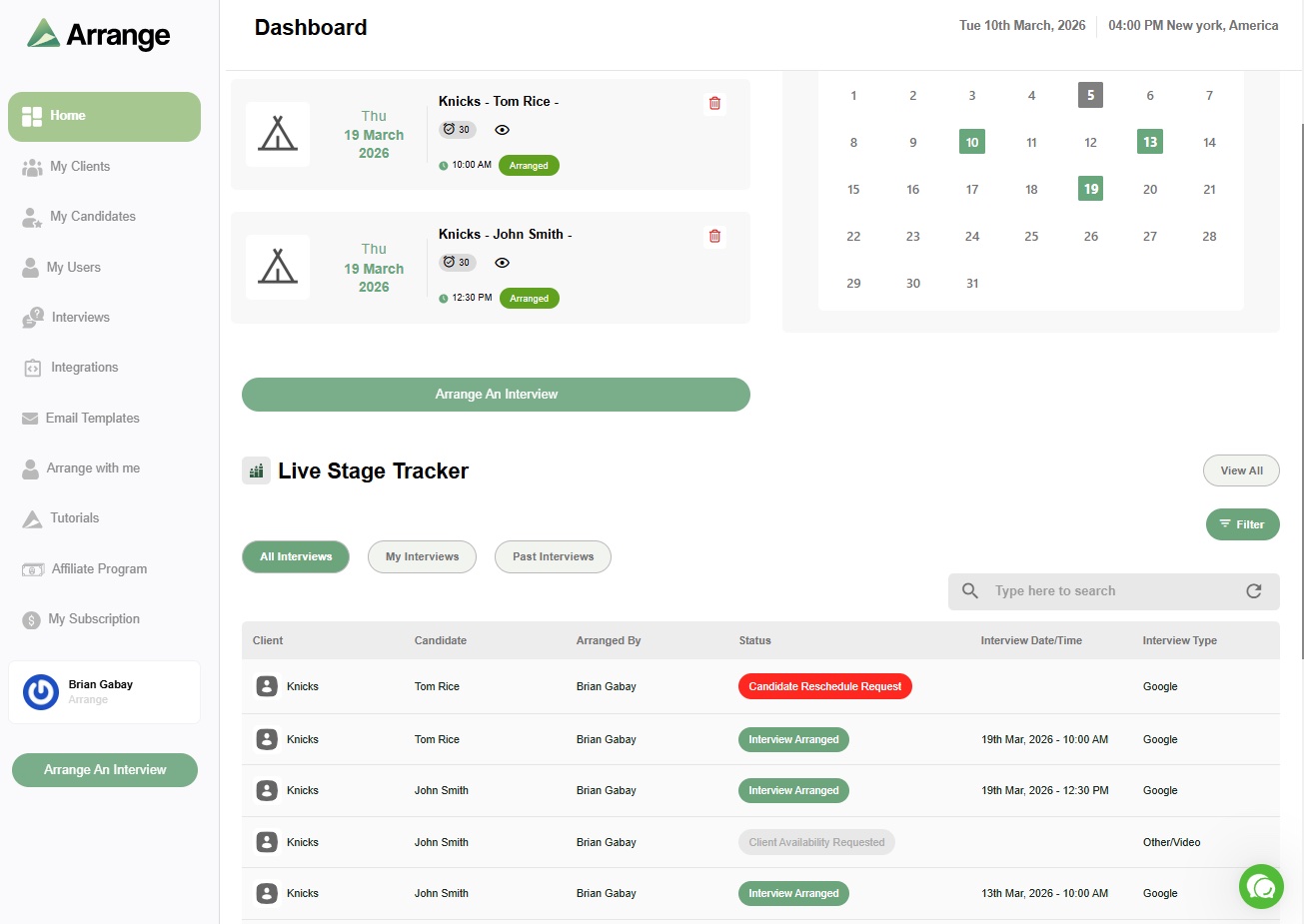
When you're running dozens of active searches at once, you can't hold every candidate's stage in your head or in a spreadsheet. A live view of where each candidate sits in the process, updated automatically as interviews get scheduled and completed, is the difference between control and chaos.
5. It has to sync with your ATS.
At high volume, double data entry isn't a minor annoyance, it's hours of lost time every week. The tools worth using pull candidate and job data directly from your ATS and push interview stage updates back, so your system of record stays accurate without manual updates.
6. It needs to hold up under audit and compliance scrutiny.
For regulated industries or larger enterprise clients, "we scheduled it over email" isn't good enough. A clear, timestamped record of who was invited, who confirmed, and when, matters more as the stakes go up.
Where this gets harder for agencies specifically
Most tools built for high-volume scheduling are built for internal talent acquisition teams managing their own hiring. Recruiting agencies have a different problem: you're the middleperson between two parties who don't work for the same company and have no reason to log into your system. That's the specific gap Arrange was built to close. Candidate First, Client First, and Matchmaker scheduling flows all work without either side creating an account, while Arrange Connect handles real-time calendar syncing so you're never manually cross-checking availability across dozens of active searches at once.
FAQ
Does interview scheduling software actually help at high volume, or is it just for convenience?
At low volume it's convenience. At high volume it's the only way to avoid double-bookings, lost candidates, and hours of manual coordination every week.
What's the biggest scheduling bottleneck for agencies running high-volume searches?
Coordinating between two external parties, the candidate and the client, neither of whom wants to log into your tools. Most scheduling software assumes both sides are internal employees, which doesn't hold for agency recruiting.
Do enterprise clients expect a formal audit trail for interview scheduling?
Increasingly, yes, especially in regulated industries. A timestamped record of invitations, confirmations, and stage changes protects both you and your client if a hiring decision is ever questioned.


.jpg)

.jpg)
.jpg)