

Most lists of recruiting automation tools are written for in-house talent teams processing thousands of applicants. Agencies have a different problem. You're running candidate searches and business development at the same time, coordinating with clients at other companies, and every hour spent on admin is an hour not spent on the conversations that lead to placements.
This list is built for agency recruiters. It's organized by the part of the desk each tool automates, so you can find the right fix for wherever your team loses the most time.
How we picked these tools
Every tool here meets three tests:
It automates real agency work. Not just features in a demo, but tasks agency recruiters repeat every day.
It fits the way agencies operate. Tools that only work when everyone shares the same company calendar or login didn't make the cut.
It connects to the rest of your stack. Automation that doesn't write back to your ATS just moves the manual work somewhere else.
Sourcing and candidate outreach
1. Pin
Pin is an AI recruiting platform that sources candidates from a large profile database, ranks them against your role, and runs multi-channel outreach sequences from the same place. You describe the candidate you want in plain language instead of writing Boolean strings, and the outreach runs automatically from there. It's used by staffing agencies, boutique firms and independent recruiters.
What it automates: candidate search, shortlist ranking and outreach sequences.
Best for: agencies that want sourcing and outreach handled in a single tool.
2. Juicebox
Juicebox combines natural-language candidate search across hundreds of millions of profiles with AI sourcing agents that keep working in the background, surfacing new matches and handling outreach on autopilot. It also includes a lightweight recruiting CRM.
What it automates: ongoing sourcing, candidate evaluation and personalized outreach.
Best for: recruiters working hard-to-fill or technical searches who want sourcing to keep running between their own sessions.
Business development automation
3. Apollo
Apollo pairs a large B2B contact database with outbound sequencing. For agencies, it's a practical way to find hiring managers and decision-makers at target companies and run consistent business development outreach without building lists by hand.
What it automates: prospect list building, contact data and outbound sequences.
Best for: agencies that want contact data and sequencing in one business development tool.
4. Clay
Clay automates research and data enrichment. It pulls information from many data providers into a single table and uses AI to research accounts, so you can build highly targeted prospect lists, for example companies that just raised funding or posted several roles in your niche.
What it automates: account research, enrichment and list segmentation.
Best for: agencies running targeted, signal-based business development rather than volume outreach.
5. Lemlist
Lemlist runs personalized multichannel outreach campaigns across email and LinkedIn, with strong tools for personalization and deliverability. Agencies use it for client prospecting, and some use it for candidate outreach as well.
What it automates: multi-step email and LinkedIn campaigns with personalization at scale.
Best for: agencies that want outreach to feel personal even when it runs automatically.
ATS workflow automation
6. Recruiterflow
Recruiterflow is an agency ATS and CRM with automation at its core. Pipeline-triggered workflows, email sequences and AI-assisted features let agencies automate stage updates, follow-ups and reminders directly inside their system of record.
What it automates: stage-based workflows, candidate and client sequences, and routine pipeline admin.
Best for: agencies that want automation built into the ATS itself rather than layered on top.
7. Loxo
Loxo combines an agency ATS and CRM with a large sourcing database and built-in multi-step outreach. For smaller agencies, it covers a lot of automation in one subscription, from finding candidates to running campaigns and tracking them through the pipeline.
What it automates: sourcing, outreach campaigns and pipeline tracking in one platform.
Best for: small and mid-sized agencies that want an all-in-one platform with automation included.
Call notes and admin
8. CoRecruit
CoRecruit (formerly Quil) is an AI recruiting assistant built for staffing agencies and search firms. It captures phone, video and in-person calls without a visible meeting bot, writes structured notes directly into your ATS, and can turn call notes into client-ready candidate submittals.
What it automates: call notes, ATS updates and submittal drafts.
Best for: agencies whose recruiters spend most of the day on screens and intake calls.
9. Zapier
Zapier connects apps that don't integrate natively, triggering actions in one tool when something happens in another. Agencies use it to fill gaps in their stack, such as creating ATS records from form submissions or posting placement alerts to a team channel.
What it automates: custom workflows between tools that don't talk to each other.
Best for: agencies with a specific integration gap and someone willing to own the setup.
Interview scheduling
10. Arrange
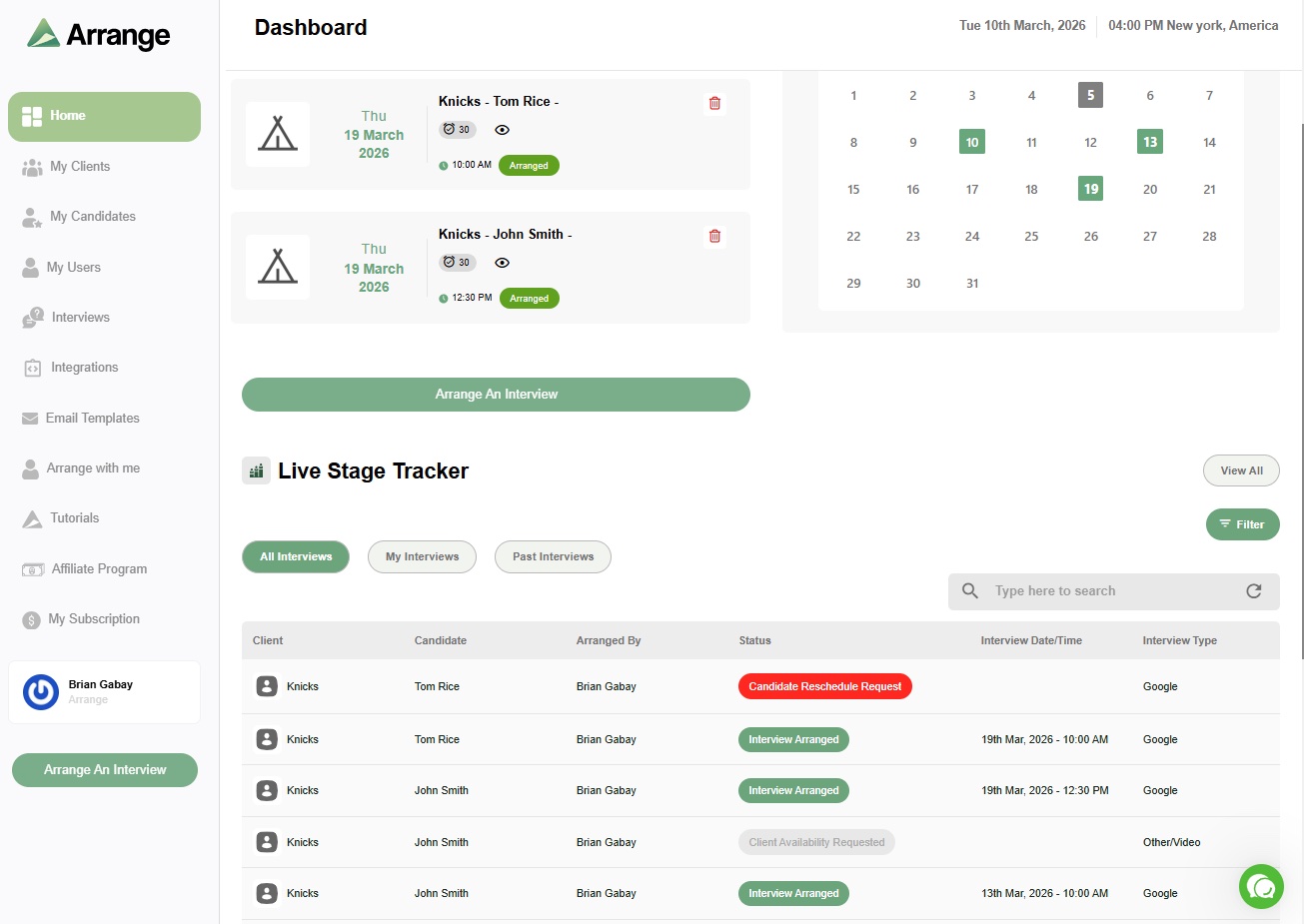
Every tool above helps you find candidates, reach them and record what happened. The step most agencies still handle by hand is getting a candidate and a client into the same interview. It's harder to automate than it looks, because you're coordinating between two people at two different companies, and neither shares a calendar with you.
Arrange automates that coordination. You can collect the candidate's availability first and let the client pick, start with the client's availability, or use Matchmaker to collect both and book the earliest overlap automatically. You can also add a Submission Link to your candidate submission, so if your client wants to meet, they click it and choose how to schedule. When volume picks up, this is what keeps bulk interview scheduling from turning into a full-time job.
Neither the candidate nor the client needs an account, everything carries your agency's branding, and confirmed interviews sync back to Loxo, Bullhorn, Crelate, Recruiterflow and Recruit CRM automatically.
What it automates: interview coordination between candidates and clients, plus ATS updates when interviews are confirmed.
Best for: recruiting agencies that want interviews booked without the back-and-forth.
Which recruiting automation tools should you start with?
Start where your recruiters spend the most time acting as messengers rather than advisors.
If finding candidates is the bottleneck, start with an AI sourcing tool like Pin or Juicebox. If the pipeline of new searches is thin, a business development stack built on Apollo, Clay or Lemlist will do more for revenue. If admin is eating the day, an AI note-taker and the automation already inside your ATS are the quickest wins. And if strong candidates stall between submittal and first interview, scheduling is where the time is going.
Whatever you choose, make sure it writes back to your ATS. For a broader look at how these tools fit together, see our guide to the best recruiting platforms for recruiting agencies.
Where Arrange fits
Arrange sits alongside your ATS and the rest of your automation stack, handling the one step built for the person in the middle: scheduling between your candidate and your client. You can start on the free plan and upgrade when you're ready to connect your ATS.
Frequently asked questions
What are recruiting automation tools?
Recruiting automation tools are software that handles repetitive recruiting tasks without manual effort, such as sourcing and ranking candidates, sending outreach sequences, capturing call notes, updating the ATS and scheduling interviews.
What's the best recruiting automation tool for a small agency?
For most small agencies, the best first step is an all-in-one ATS with automation built in, such as Loxo or Recruiterflow, since it automates sourcing, outreach and pipeline admin in one place. Add specialized tools like an AI note-taker or a scheduling tool once you've identified your biggest remaining bottleneck.
Can recruiting agencies use sales tools like Apollo or Lemlist?
Yes. Agencies sell to clients as well as recruit candidates, so sales prospecting and outreach tools work well for business development. Many agencies use them alongside their ATS to find hiring managers at target companies and run consistent outreach.