

If you've searched for a candidate availability system, you're probably tired of the same email thread: "What times work for you next week?" followed by three replies, a calendar conflict and a fresh round of asking.
What is a candidate availability system?
A candidate availability system is software that collects when a candidate can interview, keeps that information current, and matches it against the people they need to meet, so a recruiter doesn't have to gather and compare times by hand.
In practice that usually means three things working together:
- Collection: the candidate shares their availability through a simple link instead of an email reply.
- Matching: the system compares the candidate's open times with the interviewer's or client's calendar and finds the overlap.
- Booking: once a time is chosen, calendar invites go out to everyone and the interview is logged.
It sounds simple, and for a single interview it is. The value shows up when you're running dozens of candidates across several roles and the availability you collected on Monday is already out of date by Wednesday.
How it differs from a booking link
A lot of people assume a booking link like Calendly is a candidate availability system. It's close, but it works the other way around. A booking link shows the candidate the interviewer's open slots and asks them to pick one. A candidate availability system can do that, but it can also start with the candidate: they submit the windows that work for them, and the system finds a match on the other side.
That distinction matters most when the person whose calendar you need isn't someone you control. If you're an in-house recruiter, you can usually see your hiring managers' calendars. If you're an agency recruiter, the hiring manager works at your client's company, and you have no access to their calendar at all. We go deeper on that gap in how interview scheduling works when you're the middleman.
Why agencies need one more than in-house teams
In-house teams often get by with the scheduling built into their ATS, because everyone involved is in the same calendar system. Agencies sit between two separate parties, a candidate and a client, who don't share a calendar, a login or an inbox. Every interview means relaying availability from one side to the other.
A candidate availability system takes that relay off the recruiter's plate. Instead of copying times from one email into another, the recruiter sends a link, the candidate fills it in, and the client either picks from those times or shares their own. The recruiter stays in the loop without being the bottleneck.
What works well, and where these systems fall short
Most tools in this space handle the basics. Where they differ is in how well they fit an agency workflow.
What tends to work
- Candidates sharing availability without creating an account
- Automatic calendar invites once a time is confirmed
- Time zone handling, so a candidate in Chicago and a client in London see the right times
Where they often fall short for agencies
- They assume one calendar. Many tools only check the calendar of the person who owns the account, which doesn't help when the interviewer is at a client company.
- They make the client log in. Asking a busy hiring manager to sign up for yet another tool slows everything down.
- They show your branding as theirs. Some put their own name front and center on every link your clients see.
- They stop at booking. Once the interview is set, you're back to tracking stages and next steps in a spreadsheet.
If you're comparing options, our breakdown of interview scheduling vs. interview management software is a useful way to decide how much of the process you actually need covered.
What to look for
When you evaluate a candidate availability system as an agency, these are the questions worth asking:
- Can the candidate and the client both use it without logging in?
- Can it start with either side, candidate first or client first?
- Does it match availability automatically, or does it just collect it?
- Can you share it under your own brand?
- Does it keep track of where each interview stands after it's booked?
How Arrange handles candidate availability
Arrange was built by a recruiter for exactly this middle position. You can run scheduling candidate first, where the candidate shares their availability and the client picks a time, or client first, where the client shares theirs and the candidate chooses. Matchmaker compares both sides and finds the overlap automatically, so nobody is copying times between emails.
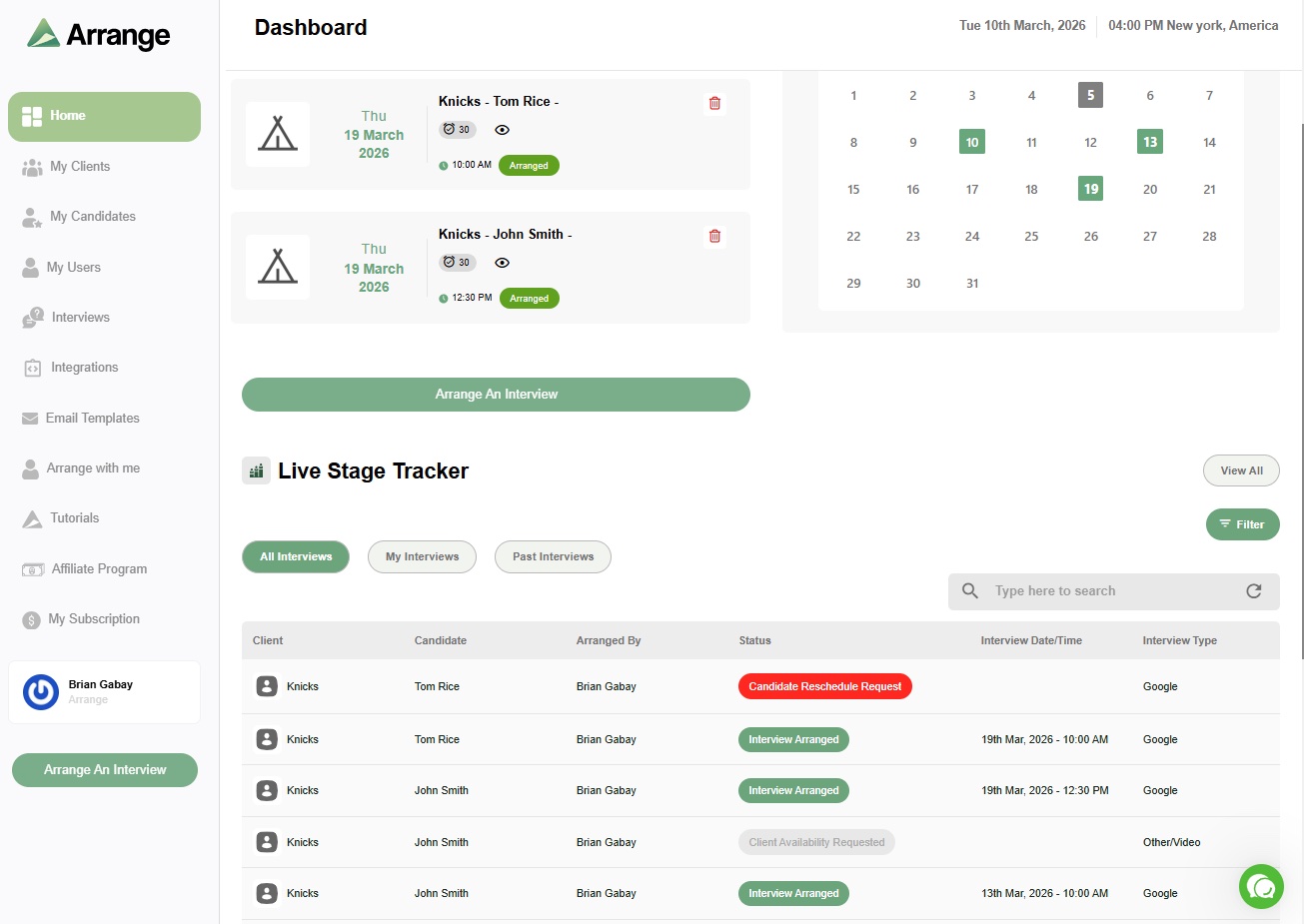
Neither the candidate nor the client has to create an account, and the experience is white-labeled, so it looks like it comes from your agency. You can also add Submission Links when you submit a candidate, letting a client request an interview the moment they like a profile. With Arrange Connect, a client can grant calendar permission through a simple link, so you can book against their real availability without ever asking for a login. And once interviews are set, the Live Stage Tracker shows where every candidate stands.
The result is less time chasing times and more time on the calls that actually lead to placements.
Frequently asked questions
Is a candidate availability system the same as interview scheduling software?
It's one part of it. A candidate availability system focuses on collecting and matching the candidate's open times. Interview scheduling software usually adds booking, reminders, rescheduling and sometimes stage tracking on top.
Do candidates need to create an account?
With a good system, no. Candidates should be able to share their availability from a link on any device without signing up for anything.
Can a candidate availability system work with my ATS?
Many can, either through a direct integration or by sending interview details back to your ATS once a time is booked. It's worth confirming how your specific ATS is supported before you commit.