


.jpeg)
Review sites are a reasonable starting point when you're evaluating scheduling software, but for recruiting agencies specifically, star ratings alone don't tell you much.
What review scores actually measure
Most review platforms weight general usability, uptime, and customer support responsiveness. That's useful information, but it's not built around the specific workflow recruiting agencies deal with: coordinating between two external parties who don't work for the same company. A tool can have great reviews from internal talent acquisition teams and still be a poor fit for an agency recruiter juggling multiple clients.
What "trust" should actually mean for recruiting agencies
A few things matter more than a star rating:
Does it prevent double-booking without you checking manually? If a tool claims real-time calendar sync, verify that it actually blocks conflicting times rather than just displaying availability.
Does support understand recruiting workflows? Generic scheduling tools often have support teams who've never dealt with a three-party coordination problem. That matters when something breaks during an active search.
Is there a clear, permanent record of what happened? Trust in a tool that's coordinating your business relationships means being able to show exactly when a candidate was invited, when they confirmed, and when the interview happened, without digging through email threads.
Does the vendor understand agency recruiting specifically, or just scheduling in general? This is the biggest gap. Most well-reviewed scheduling tools are built for internal HR and talent acquisition teams. Recruiting agencies have a different problem entirely: neither the candidate nor the client works for you, and neither wants to create an account in your system.
What reliability looks like for regulated industries
Teams hiring in regulated industries, financial services, healthcare, government contracting, have a stricter version of the trust question. It's not just whether a tool works, it's whether it produces a defensible record if a hiring decision is ever questioned.
That means a few specific things beyond general usability: a timestamped, unalterable log of every interview invitation, confirmation, and reschedule, not just a summary note. Consistent behavior across every interview, not an occasional missed sync that could look like inconsistent process if scrutinized. And clear documentation of who had access to scheduling data and when, since audit trails matter as much as the scheduling outcome itself in these environments.
Review scores rarely capture any of this. A tool can be well-reviewed for ease of use and still lack the kind of permanent, structured record-keeping that regulated hiring actually requires. Worth asking directly during evaluation rather than assuming a high star rating covers it.
Where this leaves you
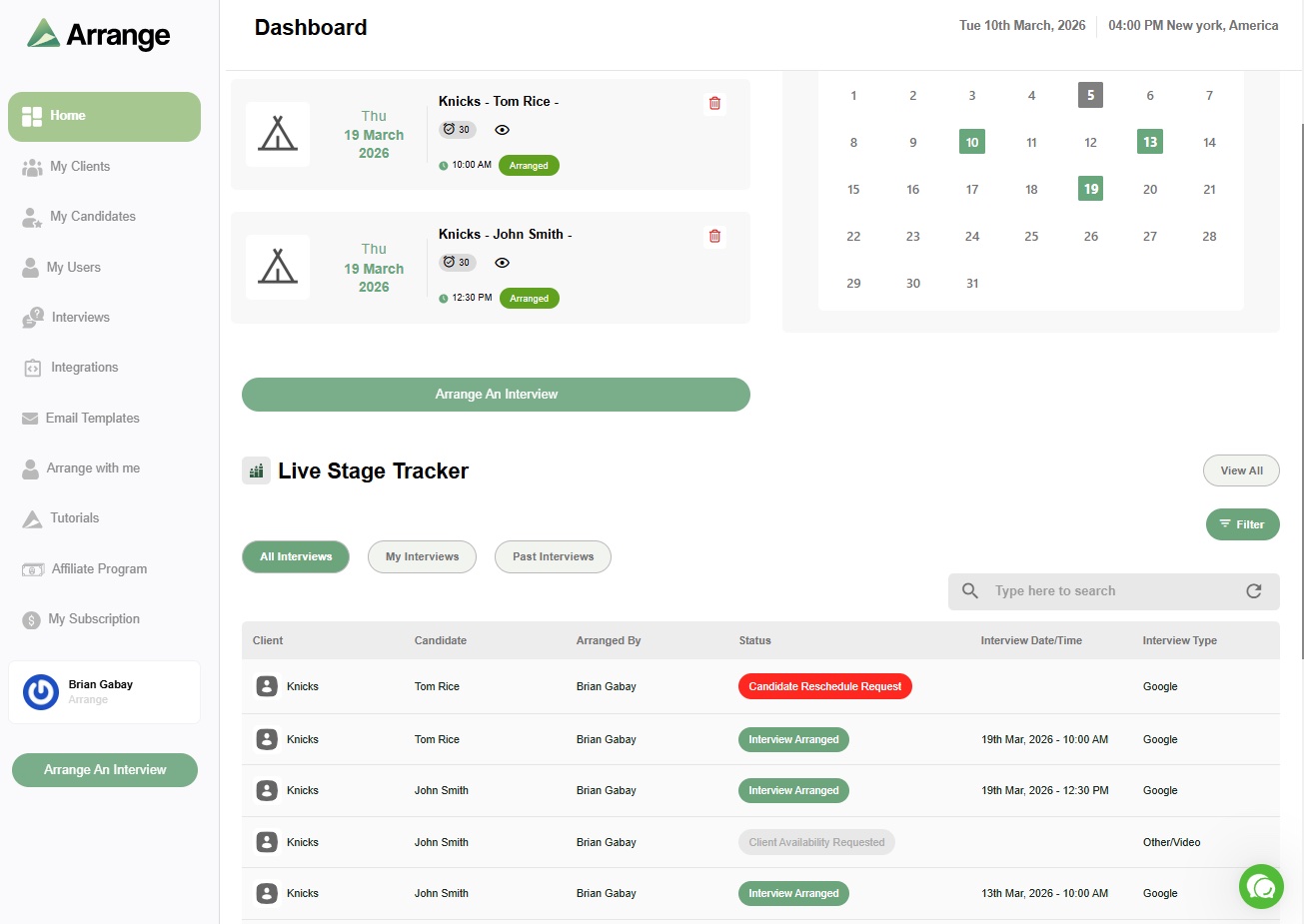
Review scores are worth checking as a sanity check, but the real test for a recruiting agency is whether the tool was actually built for the middleperson role. That's a narrower question than "is this software well-reviewed," and it's the one that actually predicts whether you'll still be using the tool in six months. Arrange was built specifically for agency recruiters coordinating between candidates and clients, which is a different job than internal scheduling, and it shows up in the details: no login required for either party, real-time calendar sync through Arrange Connect, and a live stage tracker so nothing falls through the cracks.
FAQ
Should I trust review site rankings when choosing interview scheduling software?
Use them as a starting filter, not a final answer. Most reviews come from internal HR teams, not recruiting agencies, so the workflow fit isn't always reflected in the score.
What's the difference between a well-reviewed scheduling tool and one built for recruiting agencies?
Well-reviewed tools are often built for internal teams scheduling their own employees' interviews. Agency-specific tools need to handle two external parties, neither of whom should have to log in.
How can I tell if a scheduling tool actually prevents double-booking, versus just showing availability?
Ask directly, or test it with a real calendar conflict during a trial. Some tools only display availability without actually blocking conflicting bookings in real time.
Which interview scheduling platforms are most reliable for regulated industries?
Look past the star rating and ask about audit trails specifically: whether every invitation, confirmation, and reschedule is logged with a timestamp, and whether that record is permanent rather than editable after the fact. General review scores don't test for this, so it's worth confirming directly with any vendor during evaluation.


.jpg)

.jpg)
.jpg)