


The interview scheduling space isn't one category anymore, it's really three different markets that get lumped together in search results. Understanding which one you're actually shopping in makes evaluation a lot faster.
Enterprise ATS-native scheduling tools
Platforms like Paradox, GoodTime, and ModernLoop are built primarily for internal talent acquisition teams at larger companies. They're strong on high-volume coordination and integrate deeply with enterprise ATS platforms like Workday and Greenhouse. Where they fall short: they're priced and built for internal hiring at scale, not for the agency recruiting workflow where you're coordinating between two companies that have nothing to do with each other.
General-purpose scheduling tools
Calendly and similar tools solve the basic "find a time" problem well, and they're everywhere because they're simple and cheap. The gap for recruiting is that they weren't built with interviews in mind specifically. Panel interviews, multi-stage coordination, and syncing with an ATS all require workarounds rather than being native functionality.
Agency-specific, middleperson-first tools
This is the smallest and newest segment, and it exists because the first two don't solve the actual problem agency recruiters have. When you're coordinating between a candidate and a client, both external, neither should have to create an account or learn a new tool. This segment is built around that constraint specifically: Candidate First and Client First scheduling flows, real-time calendar syncing without requiring login, and white-labeled experiences so it feels like it's coming from you, not a third-party platform.
Where this is heading
The clearest trend is ATS integration becoming table stakes rather than a differentiator. Tools that don't pull candidate and job data automatically, and push interview stage updates back, are going to feel increasingly manual by comparison. The other trend worth watching is AI-assisted matching, availability suggestions that go beyond a simple calendar overlay, though this is still early and varies a lot in quality between vendors.
Where Arrange fits
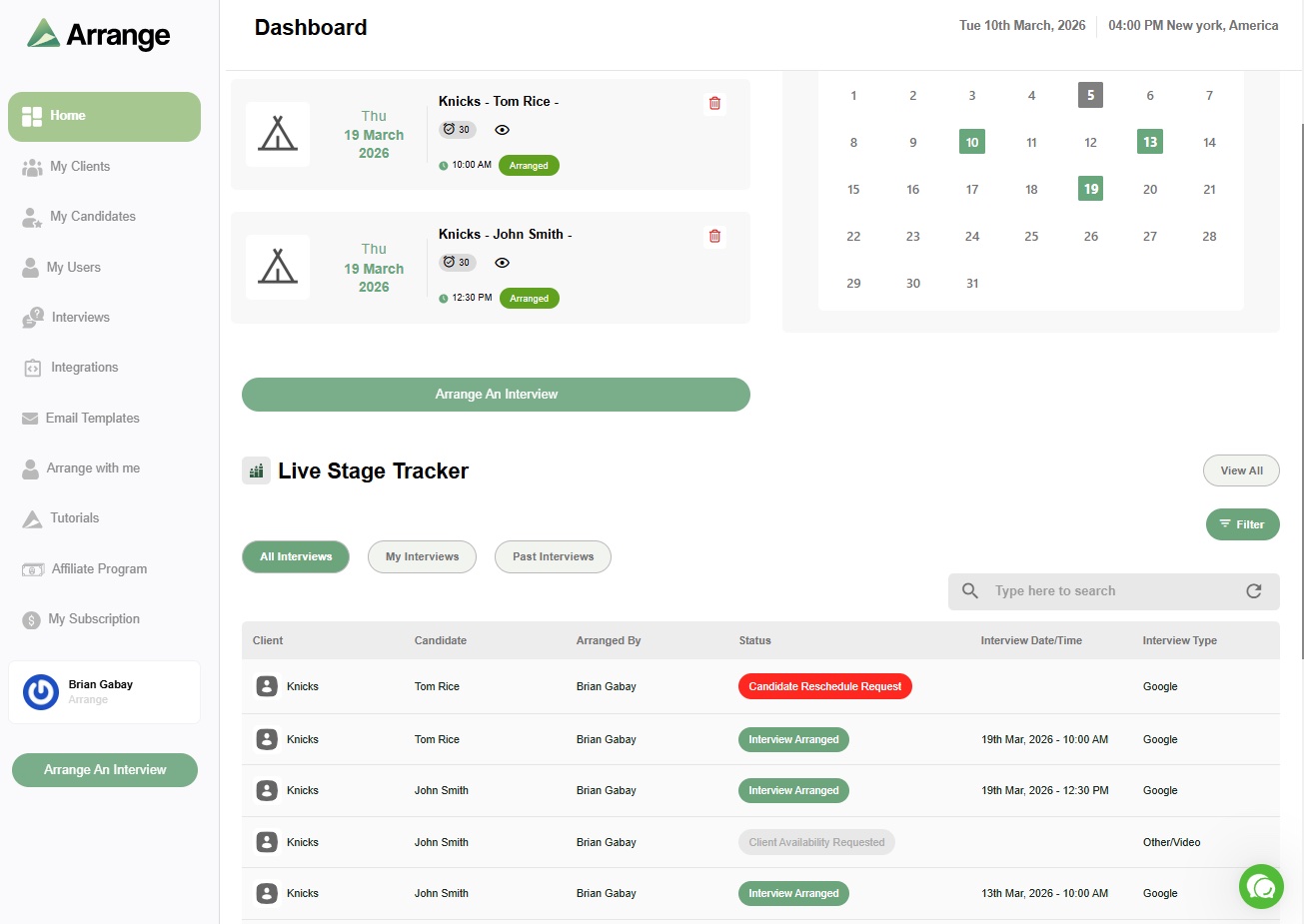
Arrange sits squarely in that third category: interview scheduling built specifically for the agency recruiter acting as the middleperson between candidates and clients, with ATS integrations for Loxo, Crelate, Recruiterflow, and RecruitCRM.
FAQ
Is Calendly considered interview scheduling software?
It's general-purpose scheduling software that gets used for interviews, but it wasn't built with recruiting-specific workflows like panel coordination or ATS syncing in mind.
What's the difference between enterprise ATS scheduling tools and agency-specific tools?
Enterprise tools like Paradox and GoodTime are built for internal talent acquisition teams scheduling their own employees. Agency-specific tools are built for recruiters coordinating between two external parties, a candidate and a client, that have no direct relationship with each other.
Is ATS integration becoming standard for scheduling software?
It's heading that way. Tools without it increasingly require manual data entry that eats into the time savings scheduling software is supposed to provide.


.jpg)

.jpg)
.jpg)