


There are hundreds of recruiting tools on the market. Most agency recruiters need far fewer than they think - and spend money on tools that add complexity rather than removing it.
This isn't a comprehensive list of every tool in every category. It's an honest take on what's actually worth paying for in 2026, based on what moves the needle for agency recruiters doing external placement work.

Sourcing: where most recruiters overspend
LinkedIn Recruiter is the default, and for most agency recruiters it's genuinely the best option for finding candidates - but it's expensive. The question isn't whether it's good, it's whether you're using enough of it to justify the cost.
If you're doing volume outreach, LinkedIn Recruiter makes sense. If you're doing targeted executive search with a small number of high-quality outreach attempts per week, you may get similar results from a Sales Navigator subscription at a fraction of the cost.
Apollo, Lusha, and similar tools are worth having for contact data enrichment, particularly for direct email and phone outreach outside LinkedIn. Most agencies don't need more than one of these.
The overspend usually comes from subscribing to multiple sourcing databases that overlap significantly. Pick one primary sourcing tool and one contact enrichment tool. More than that rarely improves output proportionally.
Outreach: the case for simplicity
Most agencies have moved to some combination of LinkedIn outreach and email sequences. The tools that handle this - Lemlist, Outreach, Salesloft, Apollo sequences - all work reasonably well.
The honest take: the tool matters less than the quality of your targeting and messaging. A well-written sequence in a simple tool consistently outperforms a poorly written sequence in a sophisticated one.
For small agencies, Lemlist tends to offer the best balance of capability and cost. For larger teams with dedicated BD functions, Outreach or Salesloft may make more sense given the reporting and pipeline integration features.
What's usually not worth paying for: multiple outreach tools running simultaneously, or adding AI writing layers on top of outreach tools that just make your messages sound like everyone else's.
Scheduling: the most underestimated tool category
Most agency recruiters treat scheduling as a cost-free activity - something that just happens through email. The reality is that for agencies doing external placement, interview scheduling is one of the most time-intensive parts of the workflow.
The core problem: you're coordinating between a candidate and a client who don't share a calendar system and have no direct relationship with each other. You're the middleperson for every exchange. That coordination overhead adds up across multiple active roles.
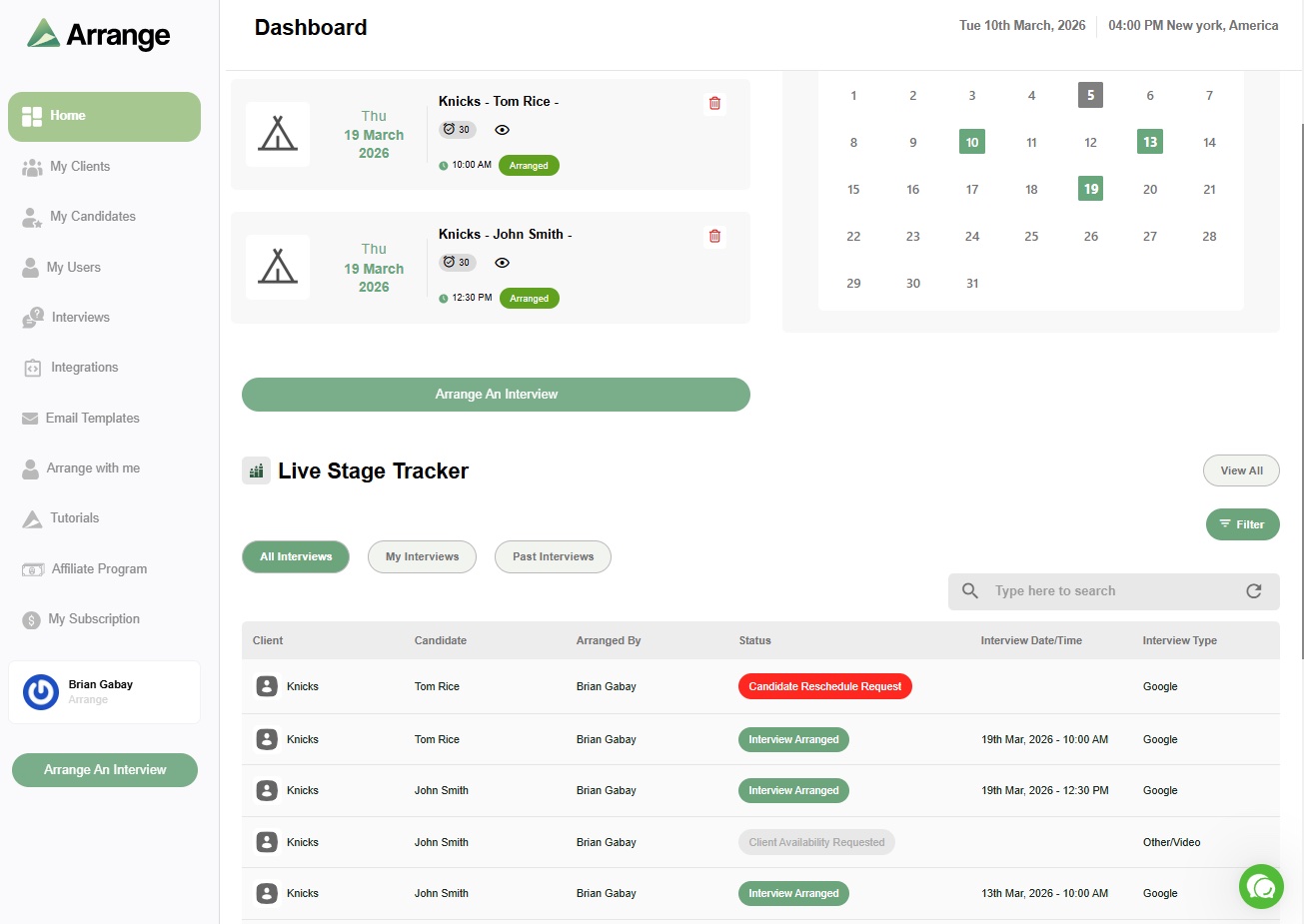
Tools in this category range from Calendly (simple, cheap, but limited for the agency use case) to GoodTime and ModernLoop (powerful, but built for in-house teams and priced accordingly). Arrange is specifically designed for the agency middleperson problem - coordinating external candidates and clients without requiring either to log in, with ATS sync built in.
This is the tool category where agencies most consistently underinvest relative to the time they spend. A purpose-built scheduling tool typically recovers its cost within the first month for agencies managing more than a handful of active roles simultaneously.
AI tools: the fastest-growing category
AI is genuinely useful in recruiting for a few specific things: writing job descriptions, drafting outreach messages, summarizing candidate profiles, and generating interview questions. For all of these, a direct subscription to Claude or ChatGPT is usually sufficient and significantly cheaper than AI features built into other tools.
Where AI currently falls short in agency recruiting: anything that requires judgment about candidate quality, relationship context, or client fit. These remain human decisions, and tools that claim to automate them should be evaluated skeptically.
AI note-taking in calls (Granola, Fireflies, Otter) is worth using if you're not already. The time saved on manual note-taking and the ability to search call history is genuinely valuable for agencies managing multiple client relationships.
Video and communication: keep it simple
Zoom and Teams cover the vast majority of video needs. Loom is worth having for async walkthroughs - sending a candidate profile with a short video explanation significantly increases response rates compared to email-only submissions in most markets.
Slack is worth using for internal team communication even at small team sizes. The searchability and channel organization pays off quickly.
What's usually not worth the premium: specialized video interviewing platforms unless your clients are specifically requesting them for structured assessment processes.
The bottom line
The tools that actually move the needle for agency recruiters in 2026 are the ones that directly reduce time spent on low-judgment coordination work. Sourcing and outreach tools help you find and reach candidates. Scheduling tools eliminate the back-and-forth coordination that happens after a client expresses interest. AI tools accelerate the writing and summarization tasks that don't require your specific expertise.
Everything else deserves scrutiny before you add it to the stack.


.jpg)

.jpg)
.jpg)