


The Hidden Bottleneck in Modern Hiring
Over the past decade, recruiting tools have gotten remarkably good at the front end of the hiring process. Sourcing tools surface passive candidates. ATS platforms track pipeline with precision. Outreach sequences automate first contact. AI tools draft job descriptions in seconds.
And yet, interview scheduling remains a manual, email-dependent mess for most recruiting teams. The back-and-forth to get a 30-minute meeting on the calendar takes days. Recruiters spend hours each week chasing availability. ATS records get updated manually - or don't get updated at all.
This isn't a technology gap. It's an assumption gap. Most scheduling tools were built for a specific workflow: an internal recruiter with access to a hiring manager's calendar, scheduling a meeting that the recruiter will attend. That's not how agency recruiting works - and it's not even how many in-house teams work once the coordination complexity grows.

1. Not Everyone Uses the Same System
The fundamental problem with most scheduling software is that it assumes all parties are in the same organizational ecosystem. The recruiter has calendar access. The hiring manager is an internal employee. The candidate is the only truly external party.
That assumption breaks down immediately for agency recruiters. Their clients are at external companies with no relationship to the agency's systems. Their candidates are people they've sourced, not existing contacts in a shared directory. Getting everyone into the same scheduling interface - even temporarily - requires asking external parties to create accounts, authenticate calendars, and learn a new interface they'll use exactly once.
Most people won't do that. And the ones who do often can't - because their employer's IT policies prevent connecting personal or company calendars to third-party tools.
2. Recruiters Are the Middle Person
When an agency recruiter submits a candidate to a client, the scheduling coordination that follows is genuinely different from anything most scheduling tools were designed for. The recruiter isn't scheduling a meeting they'll attend. They're coordinating a meeting between two parties who've never interacted, from the outside.
The typical flow: recruiter emails client asking if they want to meet the candidate. Client says yes and asks the recruiter to set something up. Recruiter emails candidate asking for availability. Candidate replies with several windows. Recruiter emails client with those windows. Client says two of the three don't work and offers alternatives. Recruiter goes back to candidate. Eventually a time is found and the recruiter manually sends calendar invites to both parties. Then manually updates the ATS.
This is a coordination problem. Standard scheduling tools solve a different problem: letting someone book time with you. They're built for the person who holds the calendar, not for the person coordinating between two calendars they can't access.
3. Calendars Don't Solve Coordination
The common instinct when facing a scheduling problem is to add more calendar integration. If everyone's calendar is connected, surely the system can find the overlap automatically?
In theory, yes. In practice, agency recruiters can't get calendar access from their clients' hiring managers. The client is an external company. Their calendar is behind their organization's authentication and IT policies. Asking them to grant calendar access to a third-party recruiting tool is a significant ask that most clients will decline - particularly at the beginning of a relationship, before trust is established.
The tools that work for agency scheduling don't require calendar access from external parties. They work through links that anyone can interact with via email - no login, no calendar connection, no account creation. The recruiter provides the structure; the client and candidate provide their availability through a simple form.
Eightfold Scheduling: Powerful, But Not Built for Coordination
Eightfold AI is a talent intelligence platform that includes scheduling functionality. It's designed for enterprise talent acquisition teams with complex hiring pipelines - the kind of organization where internal calendar access and ATS integrations with Greenhouse or Workday are standard.
The scheduling capabilities are sophisticated within that context: automated interviewer matching, panel coordination, and deep integration with the enterprise stack. For an in-house team at a large company, it covers serious ground.
Where It Falls Short:
Like most enterprise scheduling tools, Eightfold assumes you're working inside an organization where interviewers are internal employees with accessible calendars. External client coordination - where the 'interviewers' are at a separate company with no access to your systems - isn't what it was built for. Agency recruiters evaluating Eightfold for interview scheduling typically find that the coordination layer they need most isn't addressed by the platform.
A Better Approach: Built for Recruiters in the Middle
The scheduling tools that actually solve the agency coordination problem share a few characteristics: they work without requiring external parties to log in or create accounts, they support multiple workflow configurations depending on which party goes first, and they sync the outcome back to the recruiter's ATS automatically.
Key Capabilities:
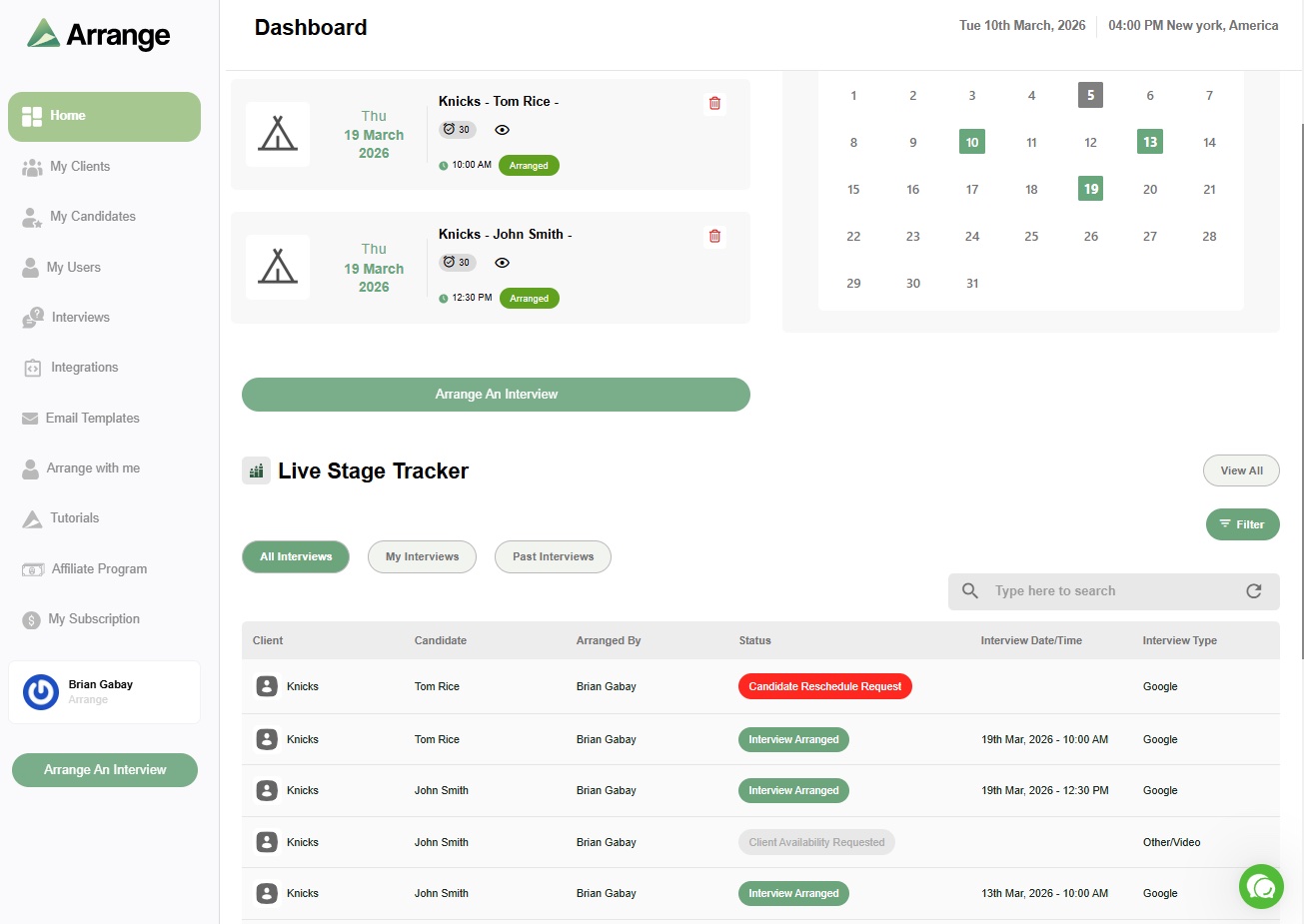
Candidate scheduling links that let clients indicate interest and initiate coordination without logging in. Multiple flow options: client-first, candidate-first, and simultaneous availability collection with auto-confirmation. Live stage tracking so the recruiter can see what's in motion across all active roles. Native ATS integration with the platforms agency recruiters actually use - Loxo, Crelate, Recruiterflow, RecruitCRM.
Final Thought
Interview scheduling software is broken for agency recruiters not because the technology doesn't exist to fix it - but because most scheduling tools were designed for a different workflow. The assumptions built into the product don't match the reality of coordinating between two external parties who don't share a system.
Building for that reality is what Arrange does. There's a 14-day free trial at letsarrange.io.


.jpg)

.jpg)
.jpg)