


If you're searching for the best ATS for interview scheduling, you've probably already noticed that almost every applicant tracking system claims to handle scheduling. Loxo, Crelate, Greenhouse, Lever, Bullhorn - they all have some version of it built in.
The question isn't whether your ATS has scheduling. It's whether the scheduling it has actually solves your problem.
For most agency recruiters, the answer is no. Here's why - and what to do about it.
What ATS scheduling was designed for
To understand why most ATS scheduling falls short for agency recruiters, it helps to understand who it was designed for.
Most applicant tracking systems were built primarily for in-house talent acquisition teams. The scheduling features inside those systems assume a specific workflow: the recruiter has access to hiring manager calendars, the hiring manager is internal to the organization, and the candidate is the only truly external party.
In that context, built-in ATS scheduling makes sense. The recruiter can see when the hiring manager is free, propose a time, and send a calendar invite. The coordination is relatively straightforward because one side of the equation is internal and accessible.
Agency recruiters work in a completely different environment. Their clients are external companies with no shared calendar access. Their candidates are external individuals with no connection to the client. The recruiter sits in the middle coordinating between two parties who have no shared system, no direct relationship, and no particular urgency to respond to each other's schedules.
Most ATS scheduling features were not built for this. They were built for the simpler, two-party internal coordination problem - and then offered to agency recruiters as well, even though the use case is fundamentally different.
How the major ATS platforms handle scheduling
Loxo

Loxo is one of the most popular ATS platforms among agency recruiters and has invested in scheduling functionality within the platform. It handles basic calendar integration and can log interview activity in the candidate record.
Where Loxo's native scheduling falls short for agency use is the external coordination layer. Coordinating availability between a candidate and a client who are both outside your organization - without requiring either of them to log in to anything - isn't what the native Loxo scheduling was built to handle seamlessly.
This is why Arrange integrates directly with Loxo. When an interview is confirmed through Arrange, Loxo updates automatically - the candidate's stage advances and the interview details are logged. The two tools work together to cover what neither handles alone.
Crelate
Crelate is a well-regarded ATS for staffing and recruiting agencies with solid pipeline management and activity tracking. Its scheduling capabilities are functional for basic interview coordination but share the same fundamental limitation as most ATS platforms - they're better suited for managing the record of what happened than for automating the coordination of getting it to happen.
Arrange's native Crelate integration closes this gap. Recruiters using Crelate can trigger scheduling through Arrange and have the outcome reflected in Crelate automatically.
Greenhouse
Greenhouse is one of the most feature-rich ATS platforms on the market and has invested heavily in its scheduling functionality. For in-house teams with access to hiring manager calendars, Greenhouse scheduling is genuinely powerful - it can read team availability, suggest interview panels, and coordinate complex multi-round interview loops.
For agency recruiters, Greenhouse's scheduling assumes organizational infrastructure that doesn't exist in the agency context. Clients are external, their calendars are inaccessible, and the three-party coordination problem isn't what Greenhouse scheduling was built to solve. Many agency recruiters who use Greenhouse as their ATS still coordinate interviews manually because the built-in scheduling doesn't map to their workflow.
Lever

Lever has strong scheduling features for in-house teams, including calendar integration and interview plan templates. Similar to Greenhouse, the model assumes internal calendar access and a two-party coordination structure. It works well for its intended use case and falls short for the external coordination challenge agency recruiters face.
Bullhorn

Bullhorn is widely used in the staffing industry and has scheduling functionality built in. For large staffing firms the platform covers a lot of ground - it's more of an end-to-end staffing operations platform than a pure ATS. The scheduling capabilities handle basic coordination but the external three-party problem is still typically managed manually or through supplementary tools.
RecruitCRM and Recruiterflow


Both RecruitCRM and Recruiterflow are built specifically for agency recruiters and handle the core ATS workflow well. Their native scheduling is functional for tracking interviews and logging activity. For the actual coordination of getting an interview scheduled between a candidate and an external client, both platforms integrate with Arrange to handle the automated coordination layer.
Why no ATS fully solves the agency scheduling problem
The reason no ATS has fully solved interview scheduling for agency recruiters isn't a product oversight. It's a structural challenge.
The core agency scheduling problem requires collecting availability from two external parties who have no shared system, finding the overlap between them, and confirming an interview automatically - without either party needing to create an account, log in to anything, or interact with each other directly.
Building that feature set well is a significant product investment. It requires designing for frictionless external user experiences, handling multiple scheduling flows depending on which party goes first, and integrating the outcome back into multiple ATS platforms. That's not a feature - it's a product.
ATS platforms are primarily records systems and workflow management tools. The external coordination layer is a specialized problem that sits adjacent to what an ATS is built to do. The ATS platforms that recognize this build integrations with purpose-built scheduling tools rather than trying to solve the whole problem natively.
The answer: ATS plus purpose-built scheduling
The best setup for agency recruiters isn't a single ATS that does everything. See the best interview scheduling software for recruiting agencies. It's a well-chosen ATS paired with a scheduling tool built specifically for external coordination.
The ATS handles what it does best - candidate records, pipeline management, client tracking, activity logging, reporting. The scheduling tool handles what it does best - collecting availability from external parties, finding overlap, confirming interviews, and pushing the outcome back to the ATS automatically.
When those two tools are connected properly, the recruiter's workflow looks like this: submit a candidate with a scheduling link included, wait for the interview to confirm, and see the ATS update automatically. The coordination in the middle happens without recruiter involvement.
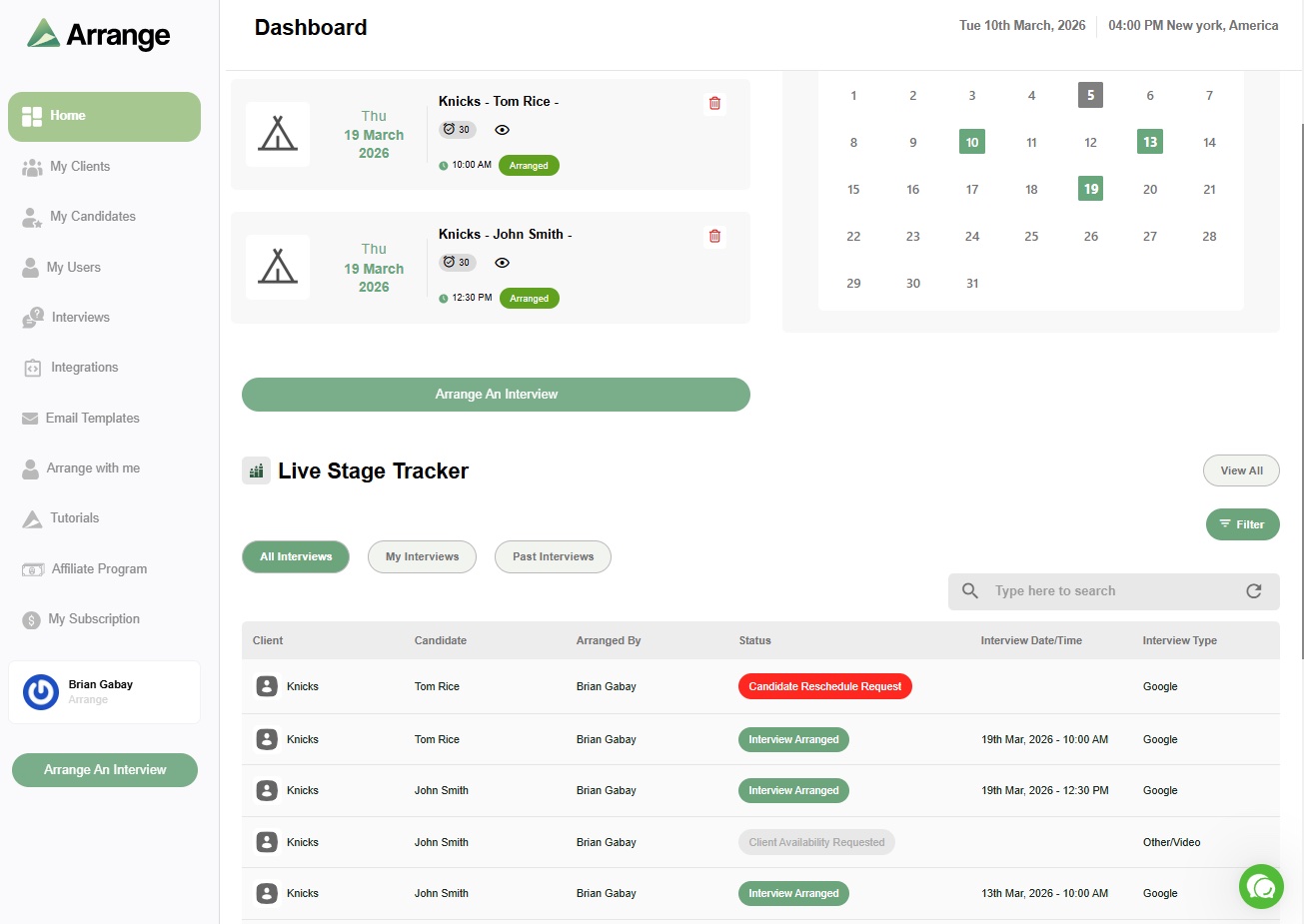
Arrange was built to be that scheduling layer. It integrates natively with Loxo, Crelate, RecruitCRM, and Recruiterflow - the ATS platforms most commonly used by agency recruiters. When an interview confirms through Arrange, the candidate's stage advances in the ATS and the interview details are logged automatically.
If you're currently relying on your ATS's built-in scheduling and still spending significant time coordinating interviews manually, it's worth seeing what a purpose-built tool changes. There's a 14-day free trial at letsarrange.io - no credit card required. See which scheduling platforms integrate with ATS systems.
FAQ
Does Loxo have interview scheduling?
Loxo has scheduling functionality built in that handles basic calendar integration and interview activity logging. For agency recruiters coordinating between external candidates and external clients, Loxo's native scheduling doesn't fully address the three-party coordination problem. Arrange integrates natively with Loxo to handle external coordination automatically, with confirmed interviews updating Loxo's candidate stages and activity logs in real time.
What's the difference between ATS scheduling and a dedicated interview scheduling tool?
ATS scheduling is primarily designed for internal teams with access to hiring manager calendars. It handles the record-keeping side of interview coordination well. Dedicated interview scheduling tools for agency recruiters are designed for external coordination - collecting availability from candidates and clients who have no shared system, finding overlap automatically, and confirming interviews without manual recruiter involvement. The two serve different but complementary functions.
Can I use my ATS for scheduling if I'm an agency recruiter?
You can, but most agency recruiters find that ATS scheduling covers the tracking and logging side of interview coordination without fully automating the coordination itself. The back and forth of collecting availability from external candidates and clients typically still happens manually. A purpose-built scheduling tool that integrates with your ATS handles the coordination automatically and pushes the outcome back to your ATS, eliminating the manual steps in between.


.jpg)

.jpg)
.jpg)