Product

Is Calendly a generic scheduling tool?

calender-image
April 16, 2026
clock-image
4 mins

Yes. And that's not a criticism - it's just an accurate description of what Calendly is and who it's designed for.

Calendly is a general-purpose scheduling platform. It's built to work for sales teams booking demos, consultants scheduling client calls, support teams setting up appointments, coaches managing their calendar, and pretty much anyone else who needs to share a booking link with another person. That breadth is the product. It's designed to be useful across industries, roles, and use cases without requiring any customization or specialized setup.

For a lot of workflows, that's exactly what you want. For recruiting agencies, it's worth understanding what "generic" means in practice - and where it starts to matter.

What generic scheduling actually means

A generic scheduling tool is one built around a universal problem: Person A needs to book time with Person B. Person A shares a link. Person B picks a slot. The meeting is confirmed. That flow works for an enormous range of situations, which is why tools like Calendly have become so widely adopted.

The design decisions that follow from that universal problem are all reasonable ones. The tool is built around the person who owns the link - their availability, their calendar, their event types. The person on the other end interacts with that link and picks a time. Simple, clean, effective.

Where generic scheduling tools reach their limits is when the problem stops being Person A booking with Person B - and becomes something more complicated.

Where Calendly's generic design creates friction for recruiters

Recruiting agencies face a scheduling problem that doesn't fit the standard mold. As a recruiter, you're not trying to get someone to book time with you. You're trying to get your client and your candidate on a call together - while you stay in the middle, coordinating both sides and keeping the process moving.

That's a three-party problem, and it requires a different kind of tool.

A few places where Calendly's generic design creates real friction for agency recruiters:

Your client's availability isn't in the system. Calendly is built around your calendar. If you want your client's open times to be part of the scheduling process, you're either asking them to share their own Calendly link - which requires them to have an account and manage their own settings - or you're collecting their availability manually over email and working around the tool. Neither is a clean solution at scale across multiple client relationships.

There's no simultaneous coordination flow. Sometimes you want to collect availability from both your client and your candidate at the same time and let the system find the first match. Calendly doesn't support that. You're running two separate conversations and doing the matching yourself.

Visibility drops once the link is sent. Calendly tells you when something is confirmed. It doesn't give you a live view of where things stand in between - whether your candidate has opened the link, whether your client is still deciding, or whether an interview is at risk of going cold. For a solo recruiter managing a handful of roles, that's manageable. Across fifteen active interviews at once, it's not.

ATS integrations don't cover agency platforms. Calendly integrates with Greenhouse, HubSpot, Salesforce, and Zoom - tools built for sales teams and in-house TA functions. The platforms recruiting agencies actually run on - Loxo, Crelate, Recruiterflow, RecruitCRM - don't have native Calendly integrations. Confirmed interviews have to be logged manually.

Where Calendly does work for recruiters

To be fair: there are parts of the recruiting workflow where a generic scheduling tool is exactly what you need.

Initial candidate screens are a good example. If you're booking a 20-minute call with a candidate to assess fit before presenting them to a client, that's a two-party problem - you and the candidate. Calendly handles that well. The candidate gets a clean link, picks a time, and the call is on your calendar. No complexity required.

Same goes for client intro calls or check-ins where you're one of the participants. If you're the one on the call, a booking link that pulls from your availability is the right tool.

The gap shows up specifically when you're coordinating a meeting between two other people - and that's the core of what agency recruiters do all day.

The distinction that matters

Generic scheduling tools are built for the person sharing the link. Recruiting-specific scheduling tools are built for the person in the middle.

Calendly is excellent at the former. It's used by over 100,000 organizations for good reason - for most scheduling use cases, it's clean, reliable, and widely recognized. But for recruiting agencies coordinating interviews between clients and candidates, the tool is solving a simpler version of the problem than the one you're actually dealing with.

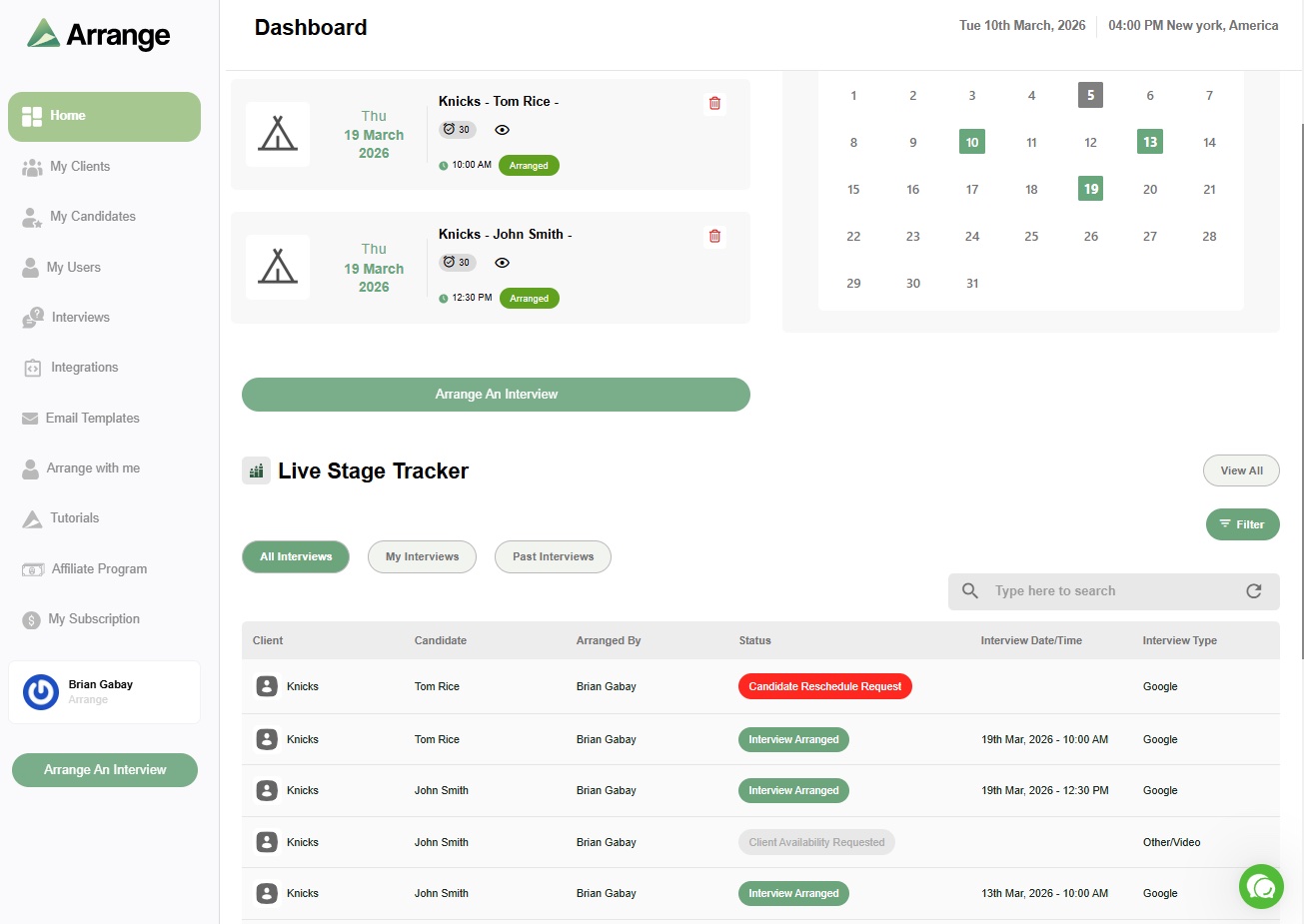
Arrange is built specifically for the middle-person workflow. Rather than assuming the recruiter is one of the participants, it's designed for the recruiter who isn't on the call - who's coordinating two external parties, collecting availability from both sides, and needs to stay visible and in control throughout without doing it all manually.

FAQs

Is Calendly good enough for recruiting agencies?

It depends on the use case. For scheduling calls where the recruiter is one of the participants - initial screens, client check-ins - Calendly works fine. For coordinating interviews between clients and candidates simultaneously, it leaves the harder parts of the process manual. Most agency recruiters who use Calendly find it covers about 30% of their scheduling workflow and doesn't touch the rest.

What makes a scheduling tool "generic" versus industry-specific?

A generic scheduling tool is built around a universal two-party problem: one person shares availability, another person books. An industry-specific tool is built around the particular workflow of a specific role or industry. For recruiting agencies, that means three-party coordination, external client scheduling, live visibility across multiple active roles, and ATS integrations with the platforms agencies actually use.

What's the alternative to Calendly for recruiting agencies?

Arrange is built specifically for external recruiting agencies. It handles client-first, candidate-first, and simultaneous availability matching without requiring login on either side, and integrates natively with agency ATS platforms including Loxo, Crelate, Recruiterflow, and RecruitCRM.

Similar Blogs