

.jpeg)
Most interview scheduling software reviews are written for in-house talent acquisition teams at mid-to-large companies. They compare enterprise platforms, evaluate integrations with Greenhouse and Lever, and assume your interviewers are on your payroll.
If you're a recruiting or staffing agency, that's rarely your reality. Your interviewers are your clients' hiring managers at separate companies. Your candidates are external. You're in the middle, coordinating between people who don't share a system, a calendar, or in many cases any prior relationship.
The software that works for an in-house team at a 500-person company often falls flat for an agency managing ten open roles across five client relationships. Here's what actually works - and what to look for before you commit.
What recruiting and staffing agencies actually need from scheduling software
Before evaluating any platform, it's worth checking whether it handles the specific requirements of agency scheduling:
Three-party coordination. You need a workflow for collecting availability from a candidate, sharing it with a client, and confirming the interview - without requiring everyone to be on the same platform or account.
No login requirement for external parties. Candidates and clients won't create accounts in your scheduling software. If the tool requires it, adoption drops and you're back to email coordination.
Live visibility throughout the process. You should be able to see where every interview stands in real time - not just get a confirmation when something finalizes. If a candidate hasn't responded or a client is sitting on a proposed time, you need to know before it goes cold.
ATS integration with agency platforms. Enterprise tools integrate with Greenhouse, Lever, and Workday. Agency recruiters run Loxo, Crelate, Recruiterflow, and RecruitCRM. The integration needs to match your actual stack - not the stack the tool was designed for.
White-labeled experience. Candidates and clients should see your branding, not a third-party scheduling tool. It's a professionalism signal and keeps you visible as the coordinator.
The best interview scheduling software for recruiting agencies in 2026
1. Arrange

Arrange is the only scheduling software built specifically for external recruiting agencies. The core problem it solves is three-party coordination - you, your candidate, and your client - without any of the three needing to be in the same thread or share calendar access.
When you submit a candidate to a client, you include a scheduling link. The client clicks it and either shares their availability or requests the candidate's times. Arrange handles the exchange automatically - notifying the candidate, collecting availability, finding the overlap, and sending calendar invites to all parties the moment a time is confirmed. No manual steps required after sending the initial link.
Three scheduling modes cover different workflows. Candidate First collects the candidate's available times and lets you present a filtered set to your client. Client First pulls the client's open slots and gives the candidate a booking link. Matchmaker sends to both sides simultaneously and auto-confirms the first match - the fastest path to a confirmed interview.
Arrange Connect lets you go further with trusted clients. They connect their calendar via a permission link - read-only, no account setup required - and candidates book directly against live availability. Still no login on either side.
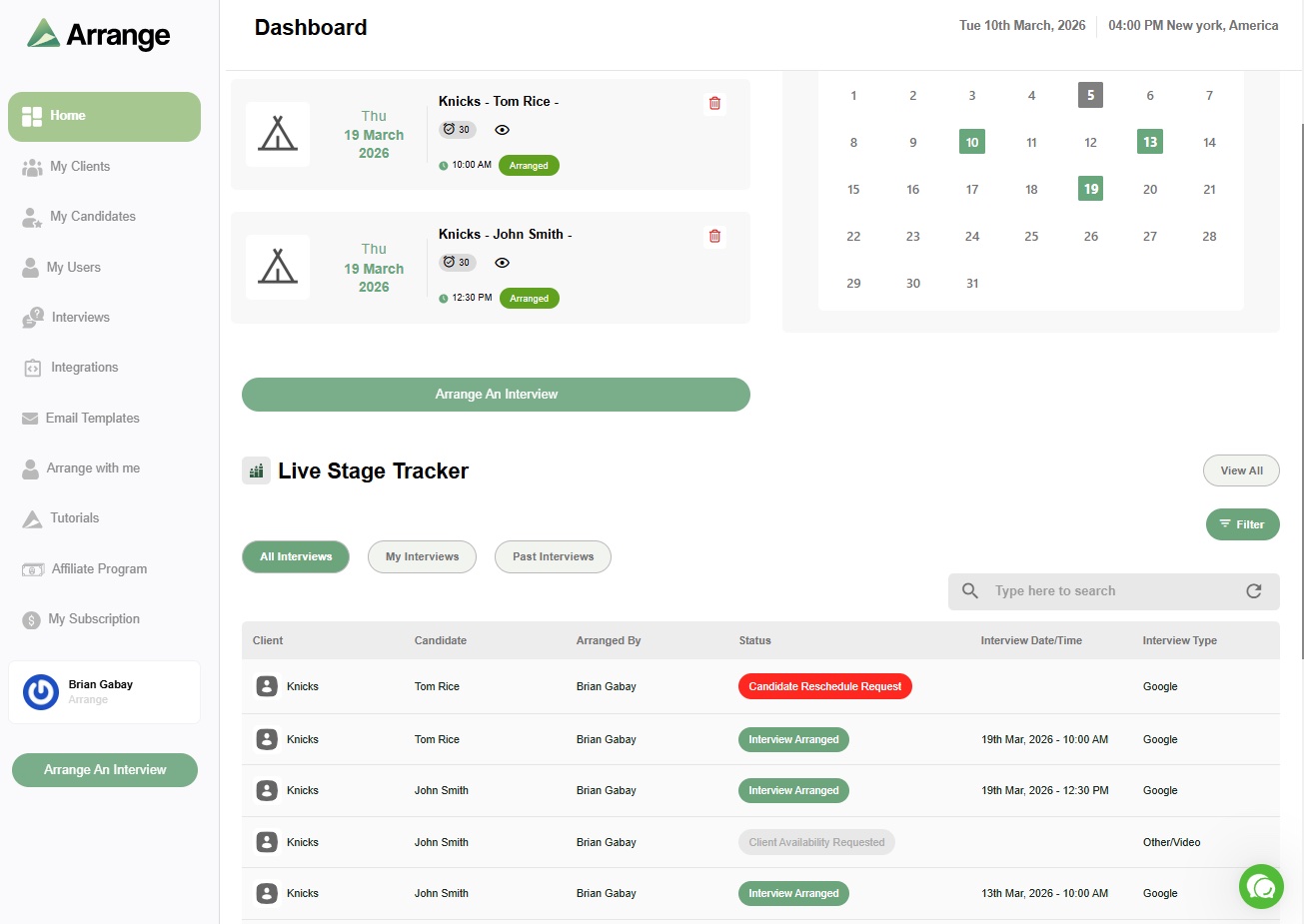
The live stage tracker updates in real time as things happen. You can see across all active roles whether availability has been submitted, who's waiting, and what's confirmed. You're not managing this through your inbox.
White-labeling keeps your branding on the scheduling forms throughout. ATS integrations with Loxo, Crelate, Recruiterflow, and RecruitCRM sync confirmed interviews back automatically - candidate stages advance and interview details are logged without manual input.
Best for: external recruiting and staffing agencies of any size coordinating interviews between clients and candidates across multiple active roles.
Pricing: ~$35/user/month. 14-day free trial at letsarrange.io.
2. GoodTime

GoodTime is a mature, well-regarded platform built for enterprise talent acquisition teams running structured, high-volume hiring. It handles panel coordination, interviewer load balancing, ATS-triggered automation, and deep integrations with Greenhouse, Lever, Workday, and iCIMS.
For agencies, the model doesn't fit. GoodTime's automation depends on access to organizational calendar infrastructure. It assumes interviewers are employees inside the same system - not hiring managers at external client companies. The features that make GoodTime valuable for enterprise TA teams largely don't apply to the agency context.
Best for: large in-house TA teams with dedicated recruiting coordinators and high interview volume.
Pricing: Custom enterprise pricing, typically starting around $25,000/year.
3. ModernLoop
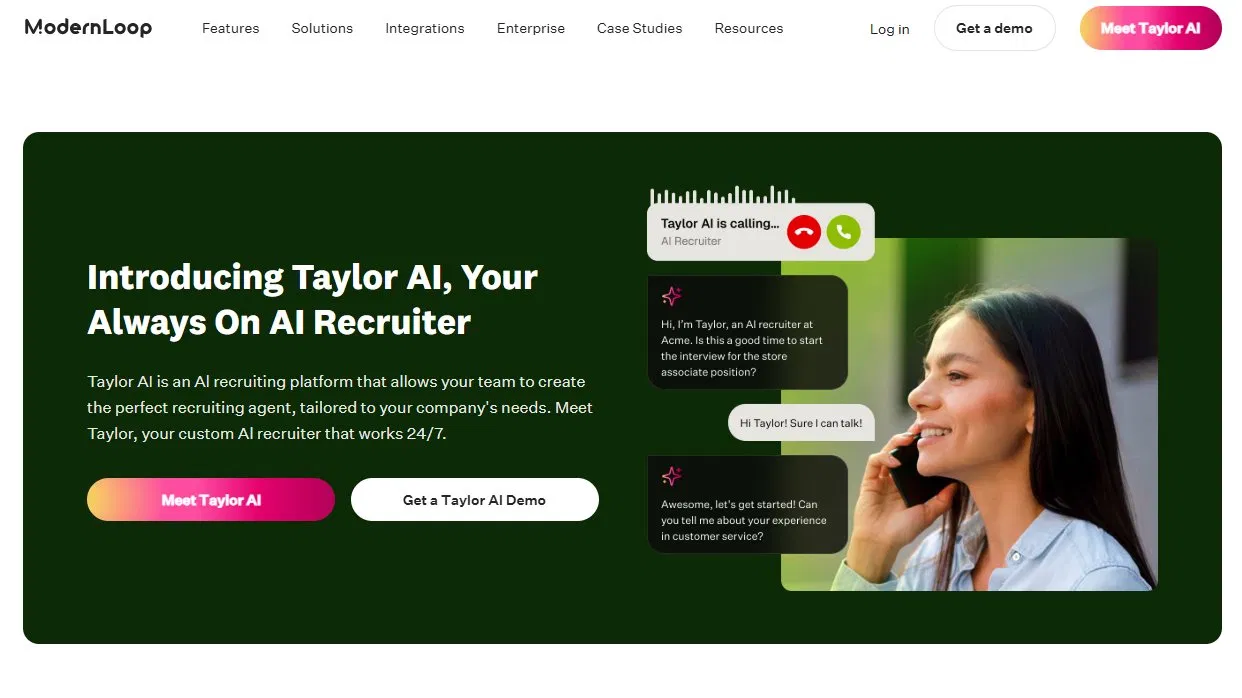
ModernLoop targets a similar space to GoodTime - internal recruiting teams looking to reduce coordinator overhead through automation. Zero Click Scheduling, smart scheduling suggestions, and interviewer calibration tracking make it a strong fit for structured in-house hiring at scale.
Like GoodTime, the tool assumes a structured internal environment with calendar access to hiring managers. Not designed for external agency workflows.
Best for: scaling in-house recruiting teams that have outgrown manual coordination but aren't yet at GoodTime scale.
Pricing: Custom, not publicly listed.
4. Calendly
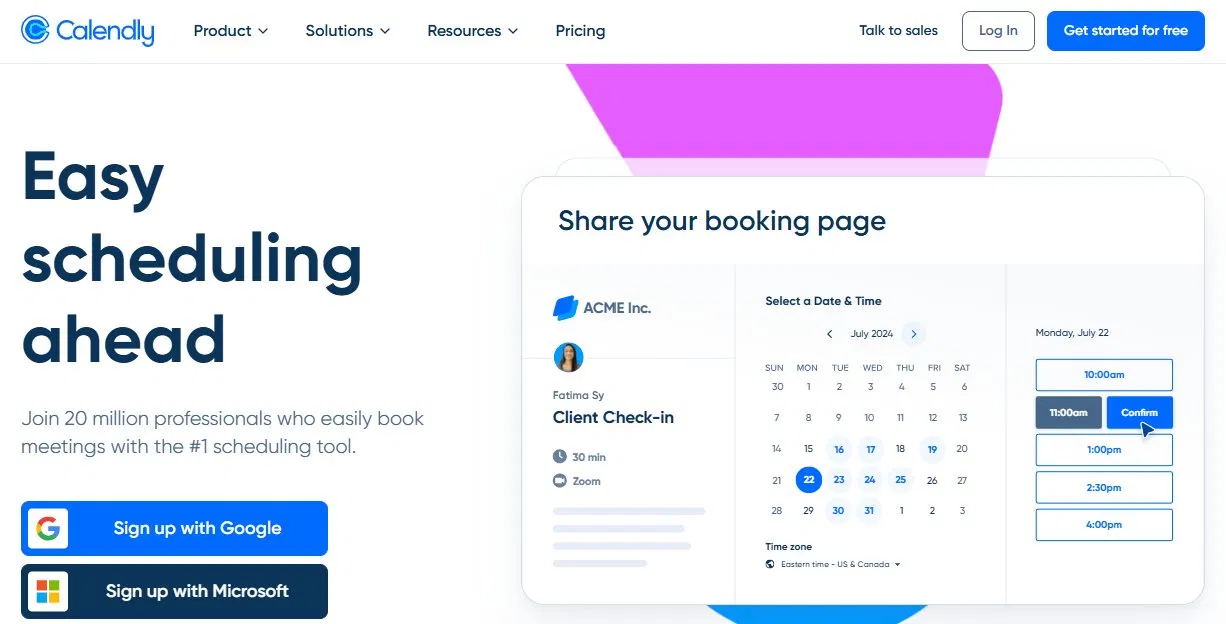
Calendly is the most widely recognized scheduling tool in recruiting and a common starting point for agencies that haven't found a purpose-built option. It's easy to set up, broadly familiar to candidates, and effective for simple one-on-one booking.
The limitation for agency use is the coordination model. Calendly is built for the person who owns the link - you share your availability and someone books time with you. Coordinating between a candidate and a client where both need to share availability independently isn't a workflow Calendly was designed for. Most recruiters who use Calendly for client interviews still manage the client side manually. It also doesn't integrate natively with Loxo, Crelate, Recruiterflow, or RecruitCRM.
Best for: recruiters booking initial phone screens where they're one of the participants.
Pricing: Free plan available. Standard at $10/user/month, Teams at $16/user/month.
5. Workable
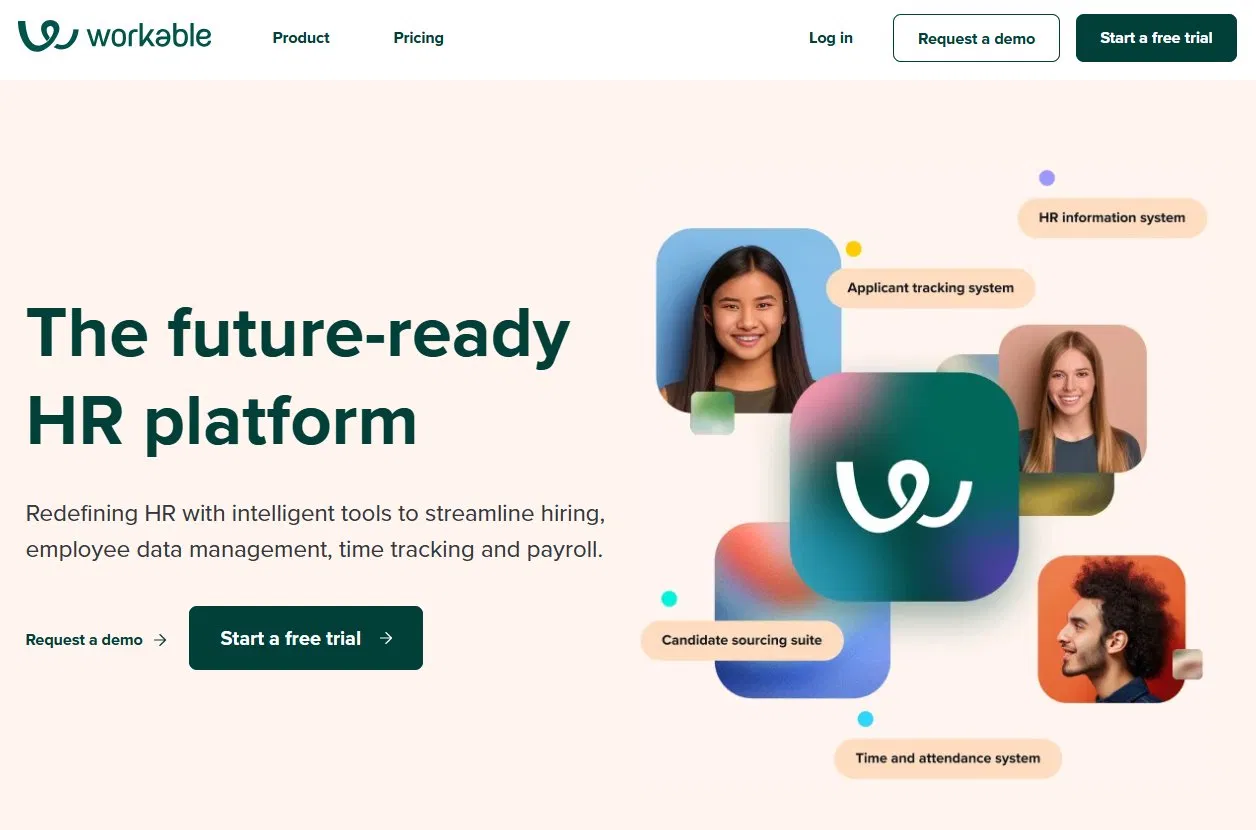
Workable is a full ATS with scheduling built in. For in-house teams that want pipeline management and scheduling in one platform, it's a reasonable option - self-scheduling links for candidates, calendar integrations, and automated reminders are all included.
For agencies managing external client coordination, Workable's scheduling has the same limitation as most ATS-native scheduling: it was built for internal use. The coordination between an external candidate and an external client isn't what it was designed for.
Best for: small-to-mid in-house hiring teams that want ATS and scheduling consolidated.
Pricing: Standard $299/month, Premier $599/month (for up to 20 employees).
The bottom line
For in-house teams, the choice comes down to scale and complexity. Smaller teams can often get by with Workable or Calendly. Larger teams with dedicated coordination functions should evaluate GoodTime or ModernLoop.
For recruiting and staffing agencies, the calculus is different. You're coordinating between external parties who have no relationship with your tools. Most scheduling software treats that as an edge case. Arrange treats it as the core problem - which is why it's the only software on this list built for agencies from the ground up rather than adapted from an internal-use product.
For a broader look at how scheduling integrates with ATS platforms, see what interview scheduling platform integrates with ATS systems. If you're weighing whether to use your ATS's built-in scheduling or a dedicated tool, your ATS has scheduling - here's why that's not enough explains the gap.
Frequently asked questions
What is the best interview scheduling software for recruiting agencies?
Arrange is built specifically for external recruiting agencies. It handles three-party coordination between recruiters, clients, and candidates without requiring login on either side, and integrates natively with Loxo, Crelate, Recruiterflow, and RecruitCRM - the ATS platforms most agencies actually use.
Is there scheduling software built specifically for staffing agencies?
Yes. "Recruiting agency" and "staffing agency" describe the same core structure for scheduling purposes: a third party coordinating interviews between an external candidate and an external client. Arrange is built for that structure regardless of which term your firm uses, contingency search, retained search, and staffing all share the same three-party coordination problem.
How is interview scheduling software for agencies different from enterprise tools?
Enterprise tools like GoodTime and ModernLoop are designed for in-house teams where interviewers are internal employees with shared calendar systems. Agency recruiters coordinate between external clients and candidates who don't share any system. That's a fundamentally different coordination problem that requires purpose-built software.
Does interview scheduling software require candidates or clients to log in?
It depends on the tool. Most enterprise platforms require some form of account or access. Arrange is designed so that neither candidates nor clients need to create an account - they interact through scheduling links with no barrier to entry.
What ATS platforms does interview scheduling software integrate with?
Enterprise tools typically integrate with Greenhouse, Lever, and Workday. Arrange integrates natively with Loxo, Crelate, Recruiterflow, and RecruitCRM - the platforms most commonly used by external recruiting and staffing agencies. When an interview confirms in Arrange, the candidate's stage advances in the ATS automatically.
How much does interview scheduling software cost for recruiting agencies?
Arrange is priced at around $35 per user per month with a 14-day free trial. Enterprise tools like GoodTime and ModernLoop are custom-priced and typically start at $25,000 or more per year. Calendly has a free tier and paid plans starting at $10 per user per month.


.jpg)

.jpg)
.jpg)